Sicily. Day 4. Trapani. Erice. Museo del Sale. Cinisi. Terrasini.
And we lived to tell the tale. No one came after us in the middle of the night, no kidnapping took place.
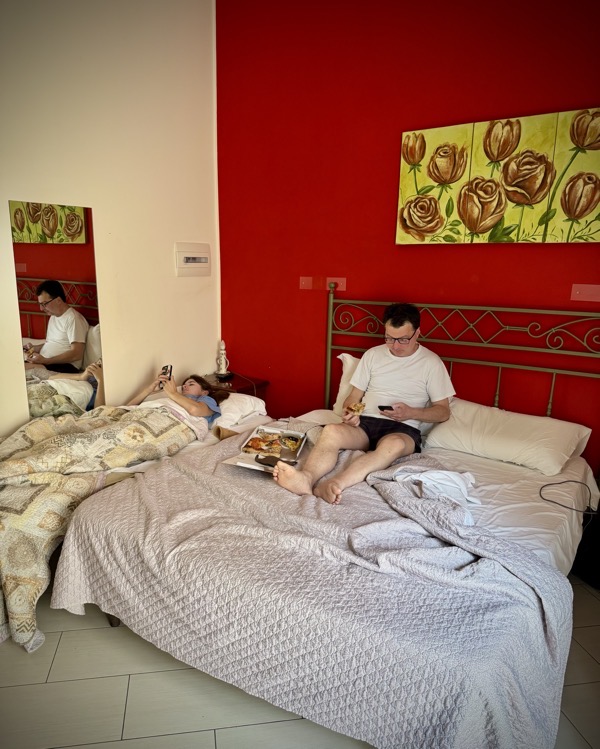
We woke up to the delicious pizza leftovers from Salemi. I love having dinner leftovers in the hotel room in the morning — no need to rush to get out of bed, get dressed, decide what and where to order. Slow planning for the day ahead, a little catchup with social media.
While my roommates were lounging I went around to see where we were actually staying. The room was fine, so was the bathroom. Outdoors? Not much to tell the family.
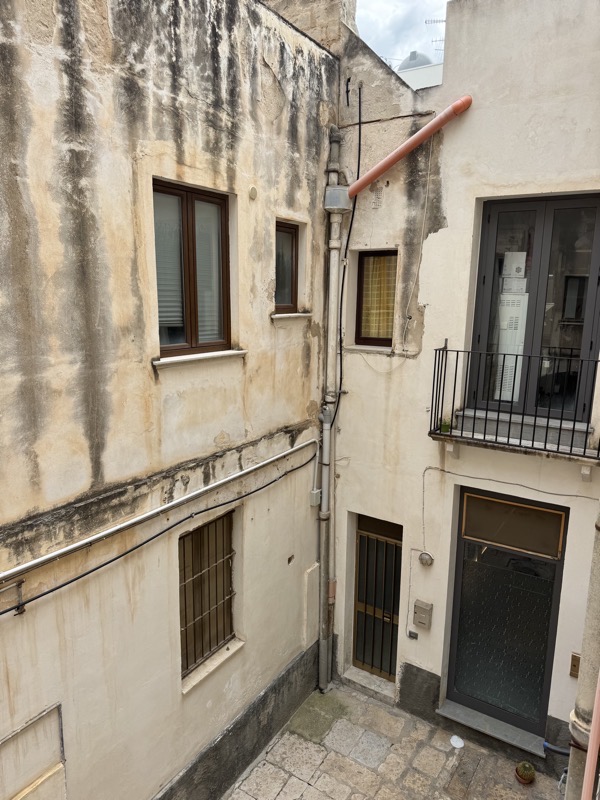
Once outside, we learned that we spent the night at Bar Caffe’ Noir Di Salone Gaspare at 128 Via Giovanni Fardella, one of the main and busiest streets in Trapani known for its shops and bars.
Internet reviews of the place where we stayed were colored with epithets like “consigliatissimo,” “eccezionale,” “esselente,” “posto ideale,” “bellissimo posto.” Our host was characterized as “un bravo ragazzo che non ti lascerà affamato e si prenderà cura di te.”
We got an idea that we lucked out. Gaspar definitely “preso cura di noi.”
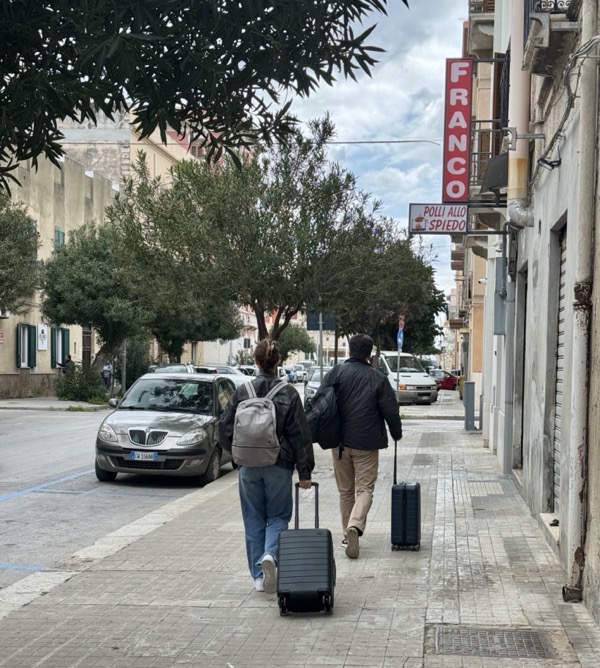
Last look back at the boulevard — all the shops we’ll never visit and all the bars where they will drink without us.
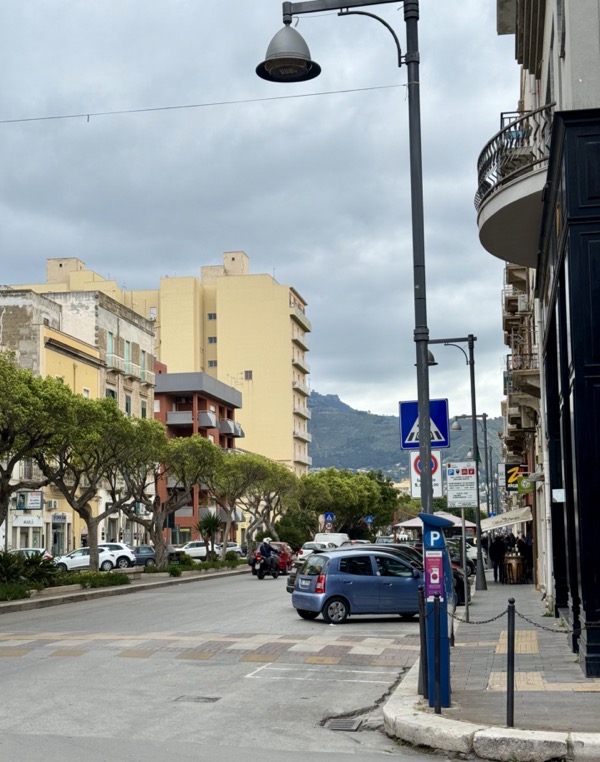
Our path was in the direction of Erice, a historic medieval town on top of a mountain about 2,500 feet above sea level.
There’s our destination — Monte San Giuliano — visible in the distance.
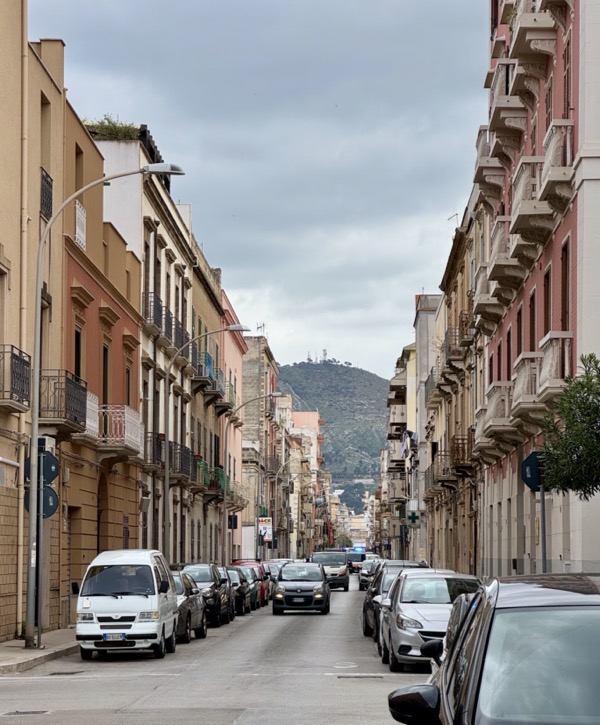
There’s a cable car from Trapani to the summit of Monte San Giuliano. It takes a couple of minutes and they say the views of the city and the islands are spectacular. For locals, it is a usual way to commute to work. For us it sounded exotic. But… as luck would have it, the cable was under maintenance. Alas and ah…
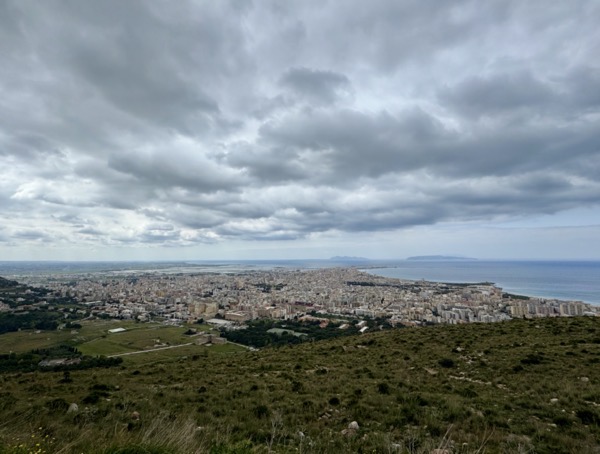
The car ride up the mountain, though, had its advantages. We could pull over any moment and take as much time as we wanted to look around and take pictures. And the terrain! But more on that white-knuckle ride later.
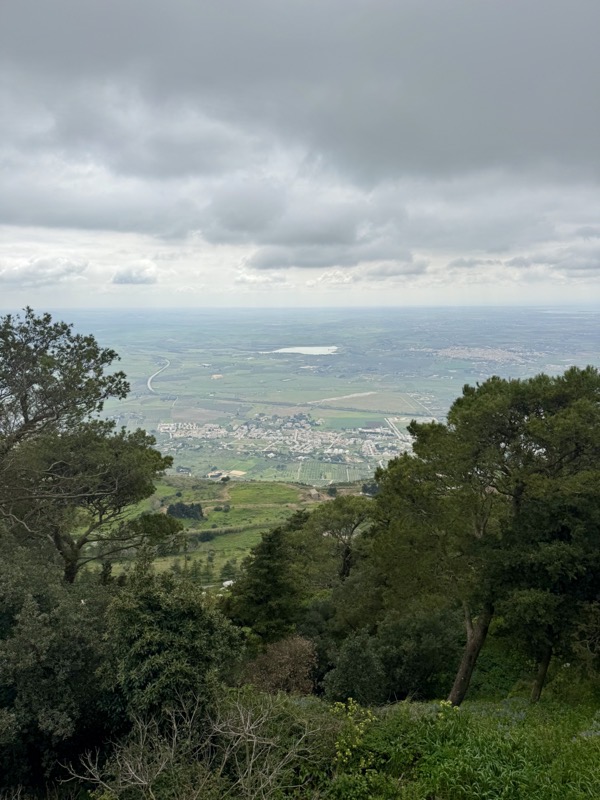
A panoramic view from a halfway climb to Erice. Below us are Trapani and the Egadi Islands.
Tom is the one who takes care of business matters on our travels. He allows me to just roll on and sop up the experience without distractions. I am lucky this way.
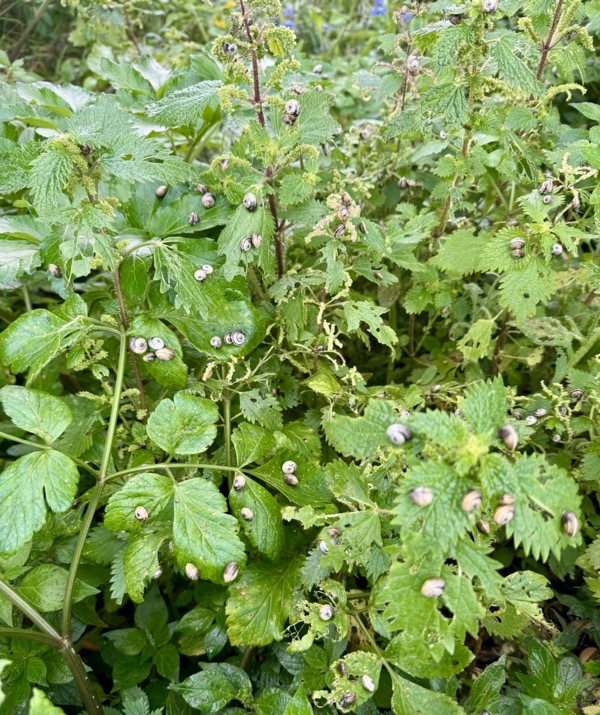
Once we got to the top of the mountain and parked next to the entrance gates of the walled town, he went to check the parking situation and my attention wandered to the curb and the most luscious tropical greenery. Greenery in Sicily is different than that in New Jersey or Central Russia, the two I know well. Here it is dark, thick and more succulent. The land around Erice was covered with tall trees. They provided protection from the sun for the growth on the floor while heat and humidity created a green house environment. There was a lot of life down here at the bottom!
Once inside the town walls, the appearance changed.
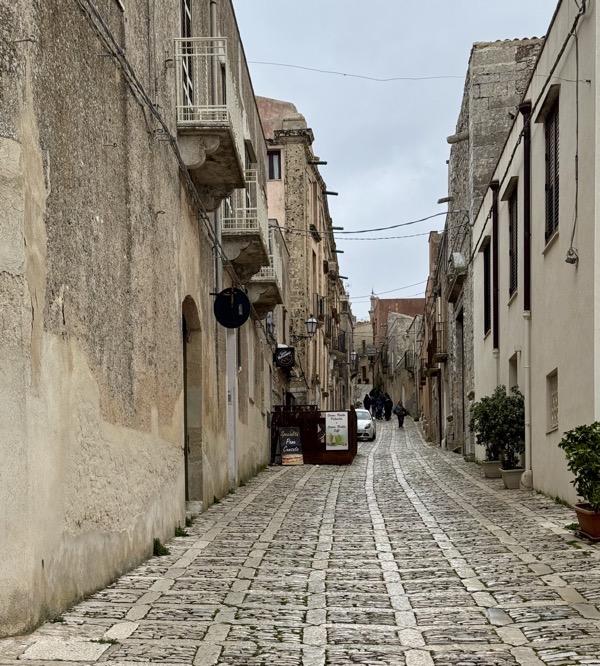
Erice is a medieval town with a piazza, a palace, a bell tower, and churches walled like a fortress. It is a preserved museum of Middle Ages in the open air. Inside, there was a labyrinth of cobblestone lined narrow channels between walls made from stones of the same color. The town looked exquisitely monochrome.
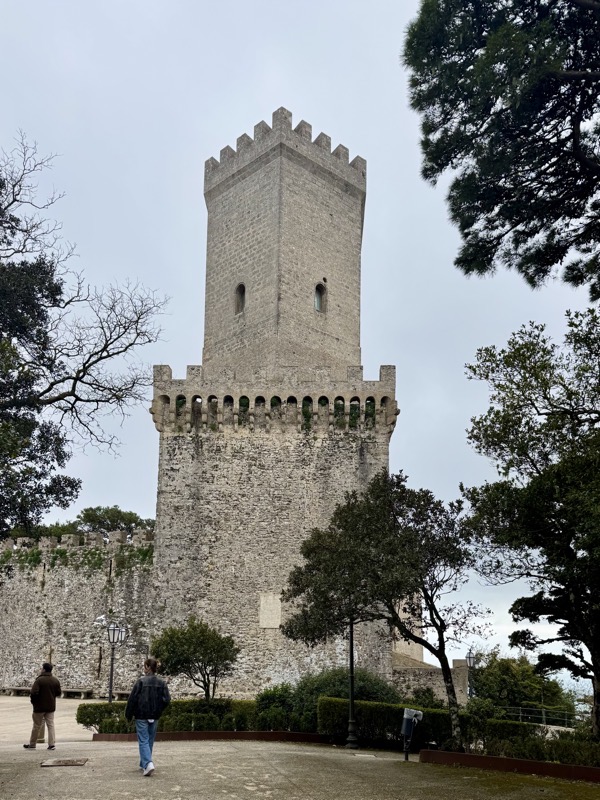
We entered Erice from the gate Porta Trapani on the side of the most important church — Chiesa Matrice or Mother Church of Erice — and its Bell Tower.
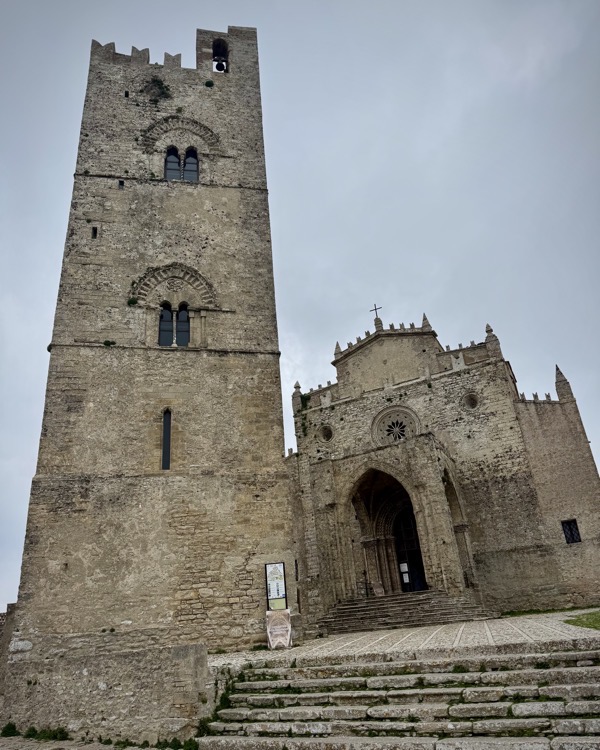
We started with the tour of the Torre di Re Federico, the bell tower of Erice’s main cathedral. Although part of the cathedral, the tower stands apart and has a separate entrance.
The passages are narrow but it was not too difficult to get to the top.
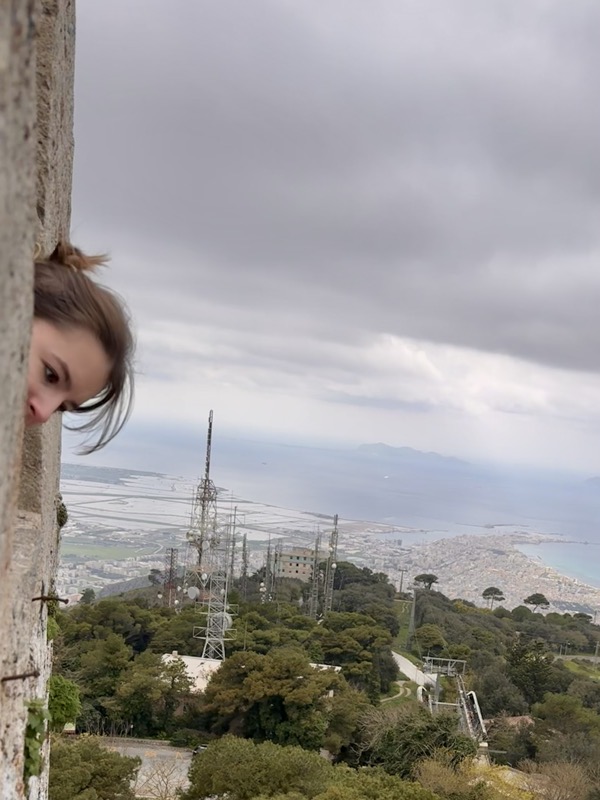
From the narrow windows at the top, there are more views of the sea and Trapani. Even though the sky started cloudy, lots of details were visible.
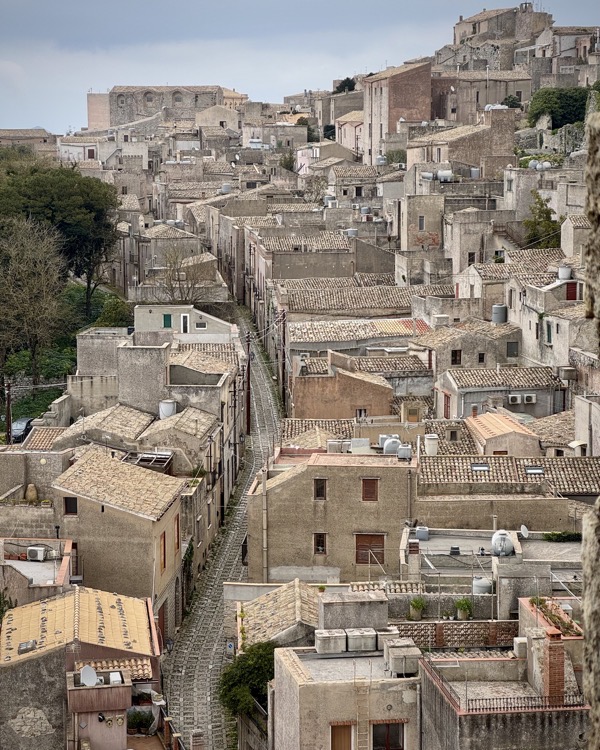
In the other direction, there were the picturesque monochrome roofs of Erice. And not just the roofs. Those paving pebbles blend seamlessly with the walls and that fit the town’s signature style.
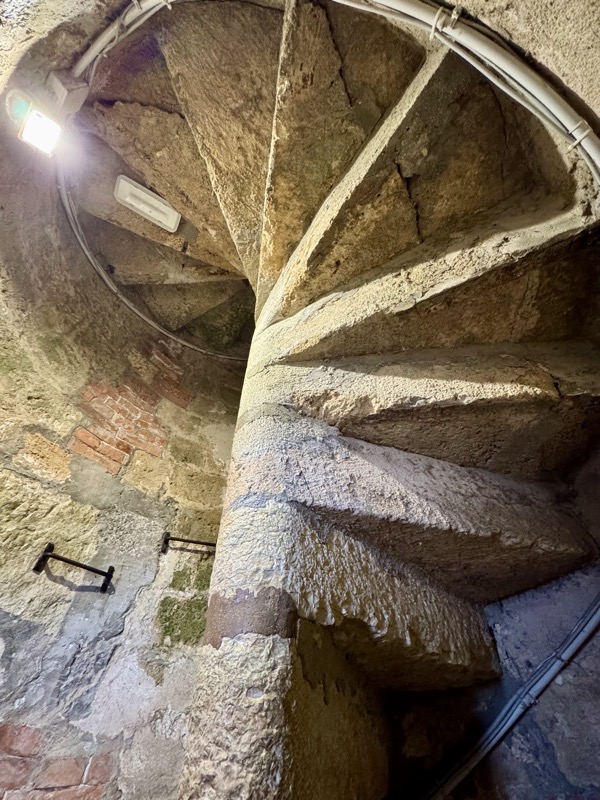
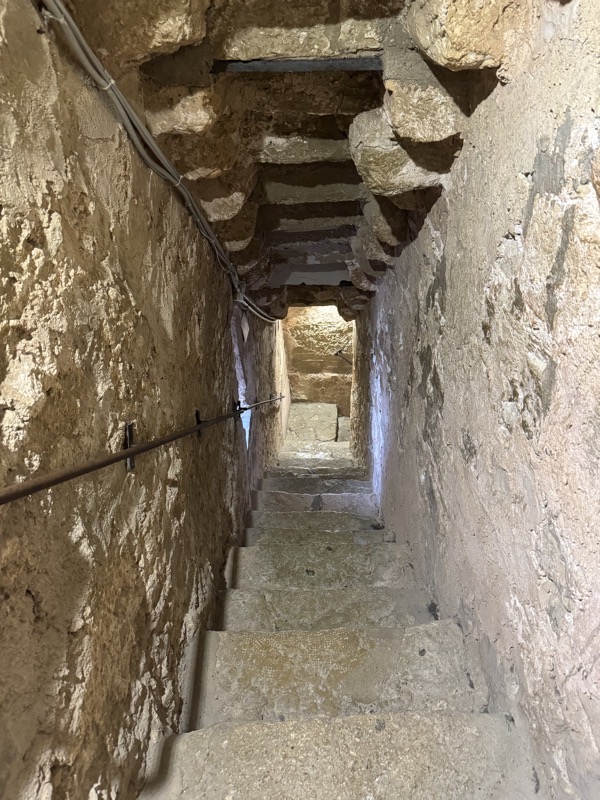
Down the spiral staircase holding on to the brackets.
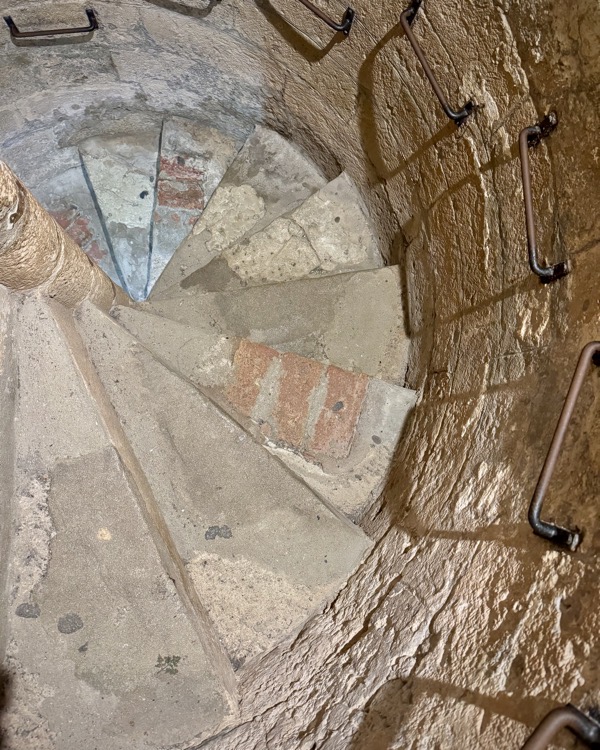
The staircases up and down are narrow with low ceilings, and huge stairs of uneven height. The banister was essential.
The beginning of the construction of this cathedral dates as far back as the 4th century AD. Over time, the church was enriched with various additions — carvings, paintings — and almost completely rebuilt 200 years ago.
The difference between ascetic exterior and intricate interior was dramatic.
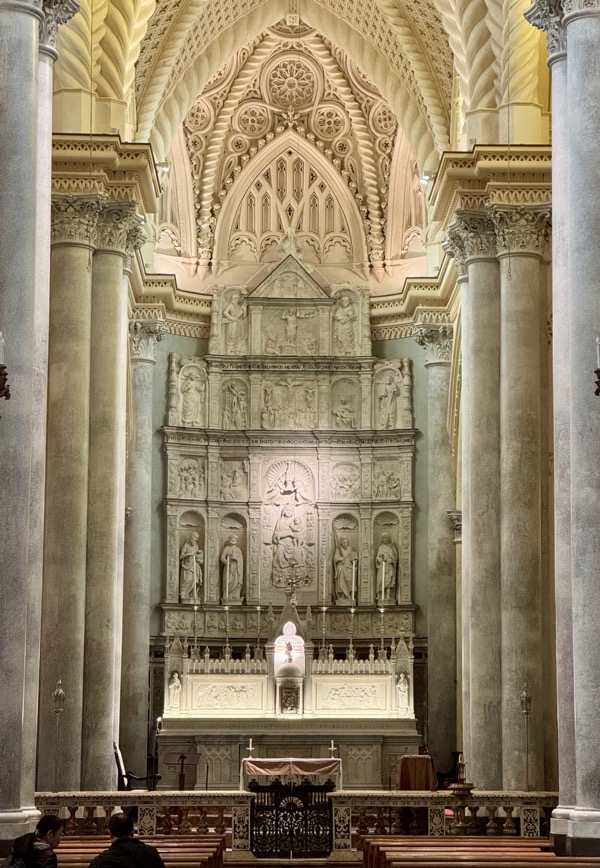
The inside pillars made of limestone frame the huge marble altar picturing Madonna in the center and various scene of the life of Christ.
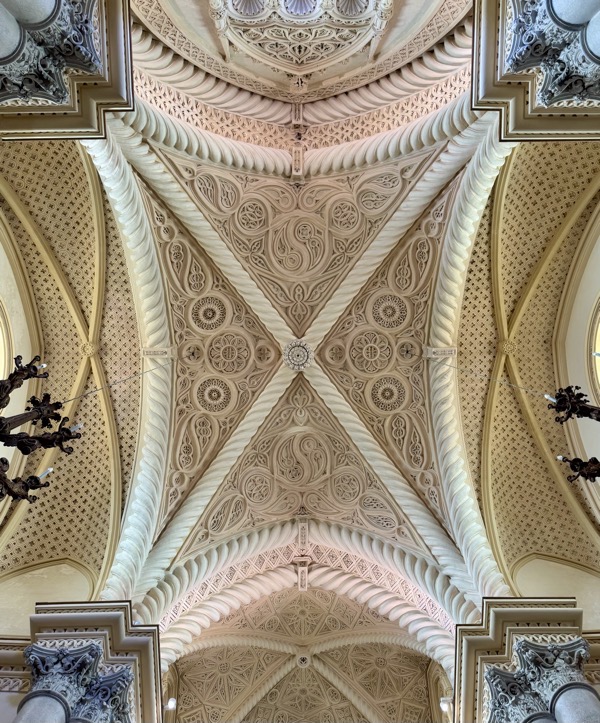
The ceiling of the cathedral is probably its most attractive feature. This is just a small fragment of it. You can easily sit and stare at the intricate carvings for hours.
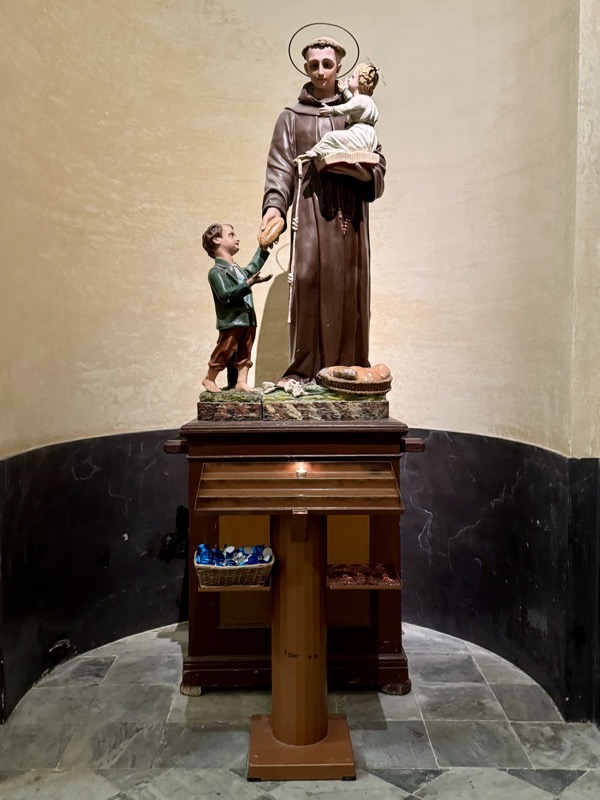
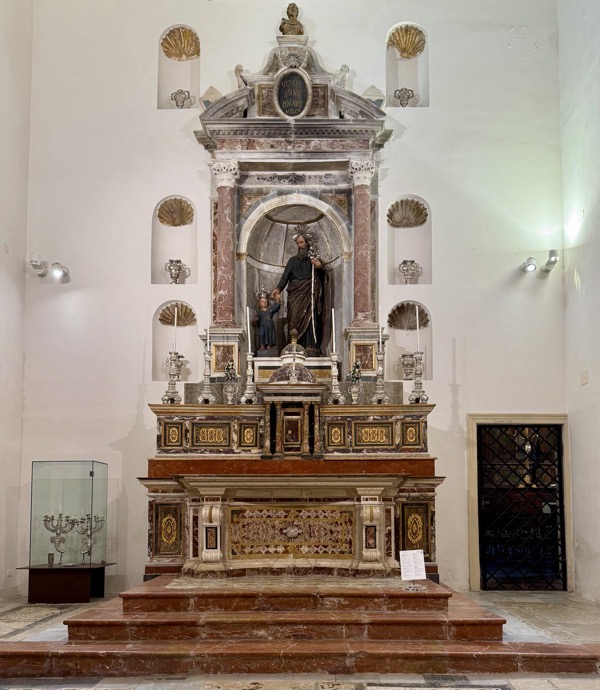
Throughout the church there are various monk figures picturing religious life in the monasteries of the town.
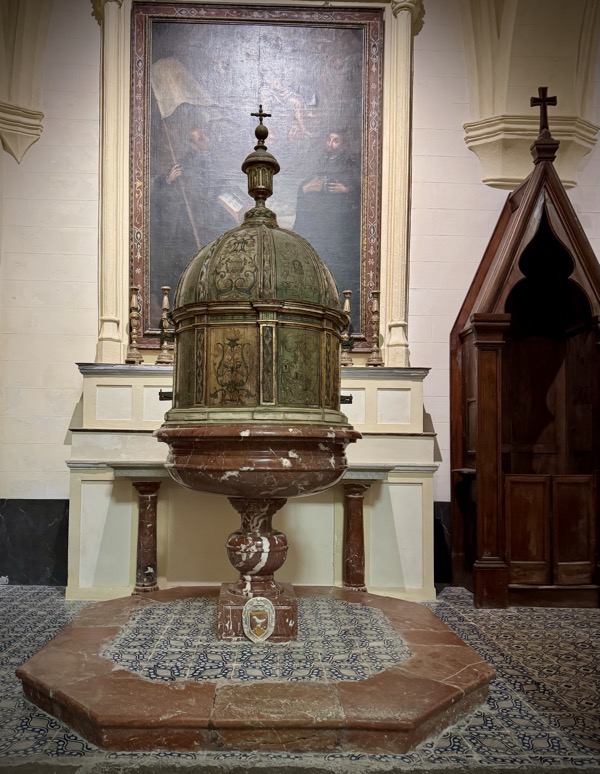
Baptismal font — dark and mysterious.
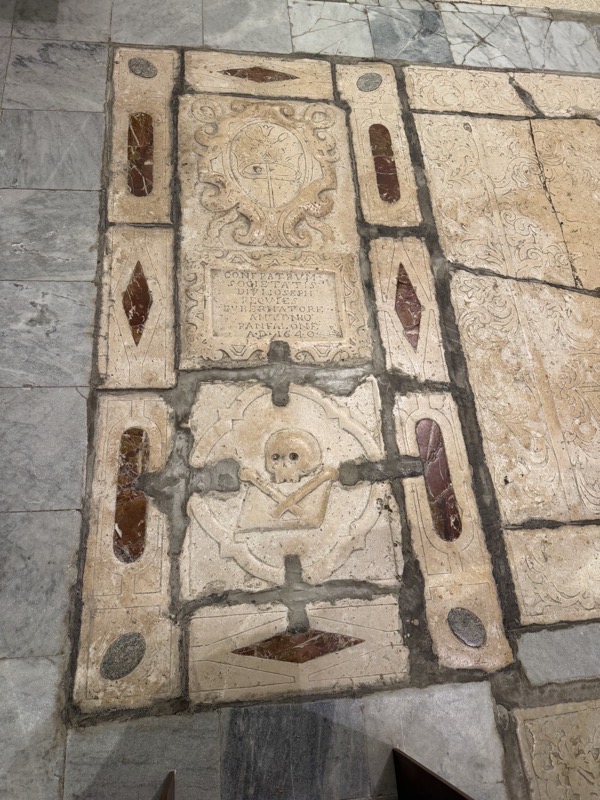
In the floor of the cathedral, there are tombstones and gravestones of notable people. Some are decorated with coats of arms, skulls, and various religious verses.
Inside the church there is also a Treasure Museum with displays of religious silverware, textiles, and more scenes of the town’s life.
By the entrance to Erice, there is a map with two different routes around town — a longer one and a shorter one. I do not remember which route we chose but eventually we gave up on following directions and got somewhat lost along the cobblestone streets.
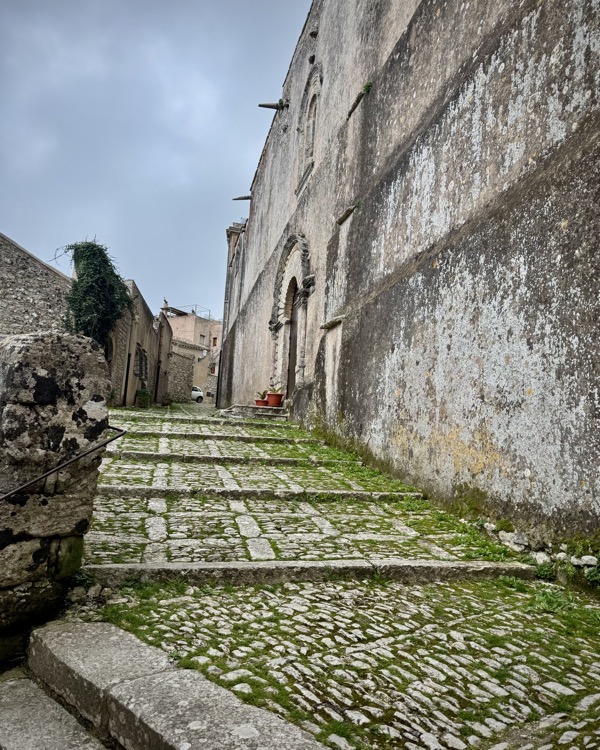
Erice is almost completely closed for car traffic and that is a huge part of its charm. The narrow back alleys not included in the maps and leading to nowhere in particular were especially attractive.
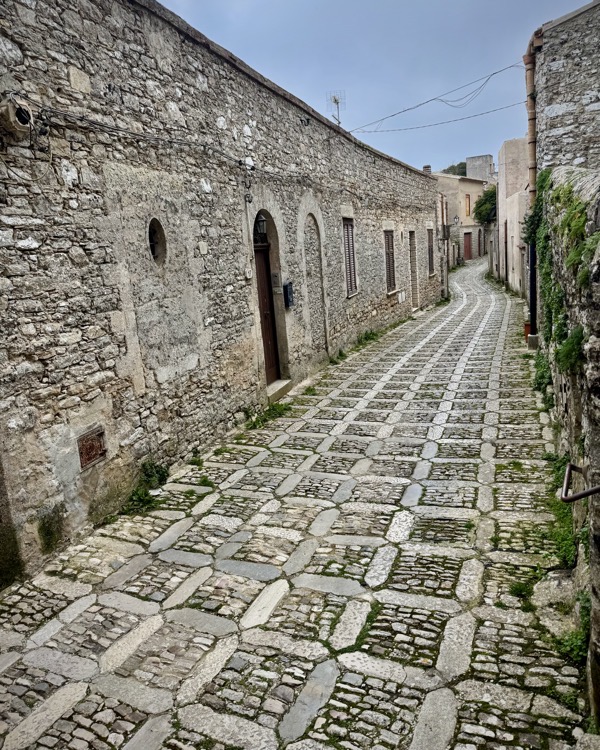
Not too many street signs and even though the triangular shaped town is small it is not difficult to get lost here.
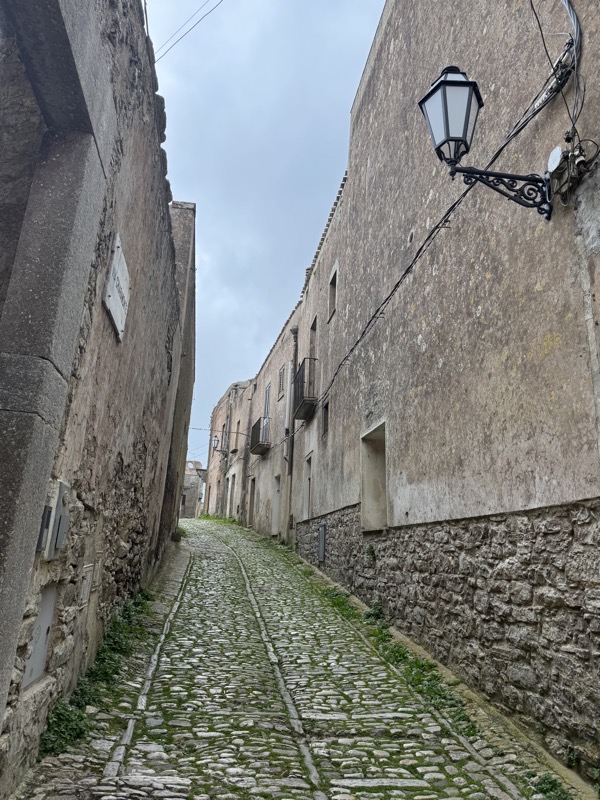
It is at this intersection we gave up on the initially planned route and made our first random turn.
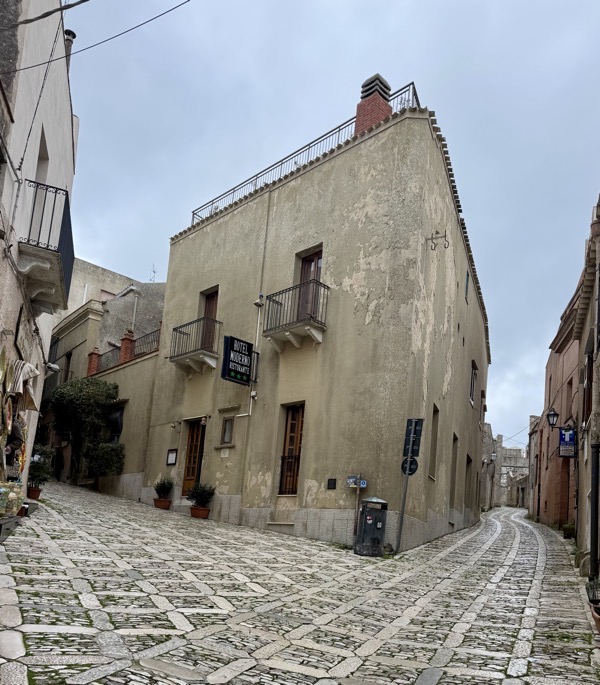
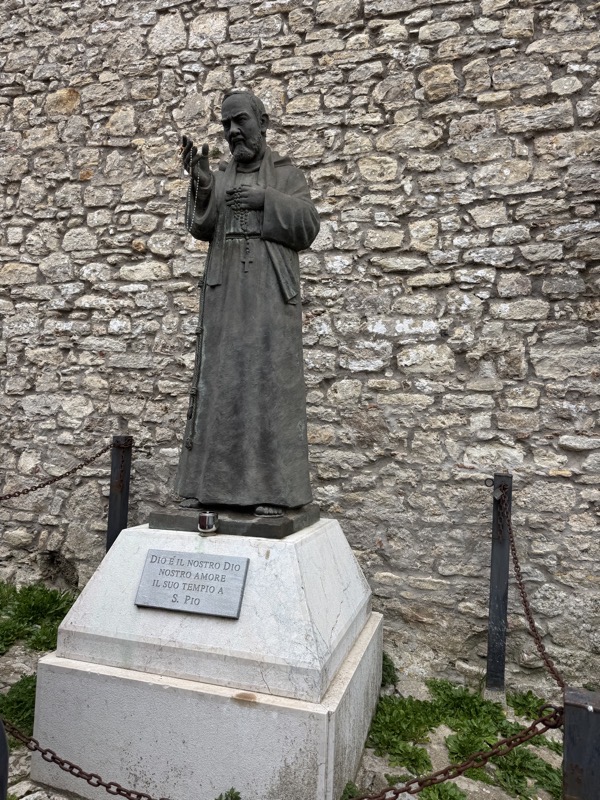
A bronze statue of Saint Pio, a highly respected Franciscan friar, stands close to the center of town.
Some of the smaller outlets had no signs of human activity whatsoever. They would quickly dead end into a door or a wall and we had to turn back to the wider — main roads.
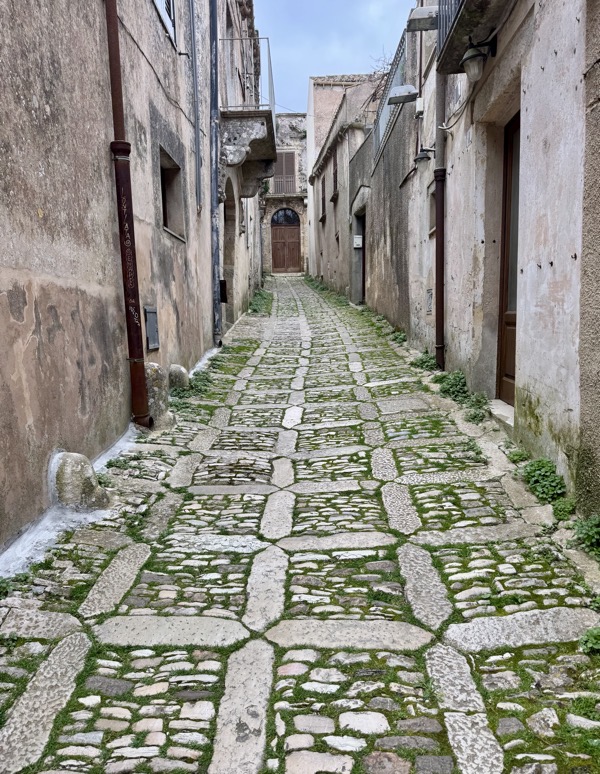
Eventually we reached the center of the town with all its shops and restaurants. Low season and chilly weather slowed down business.
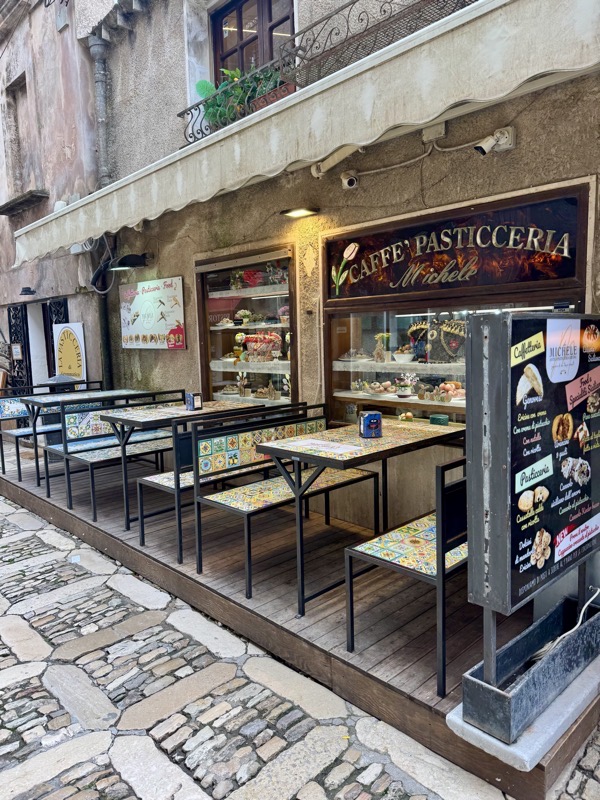
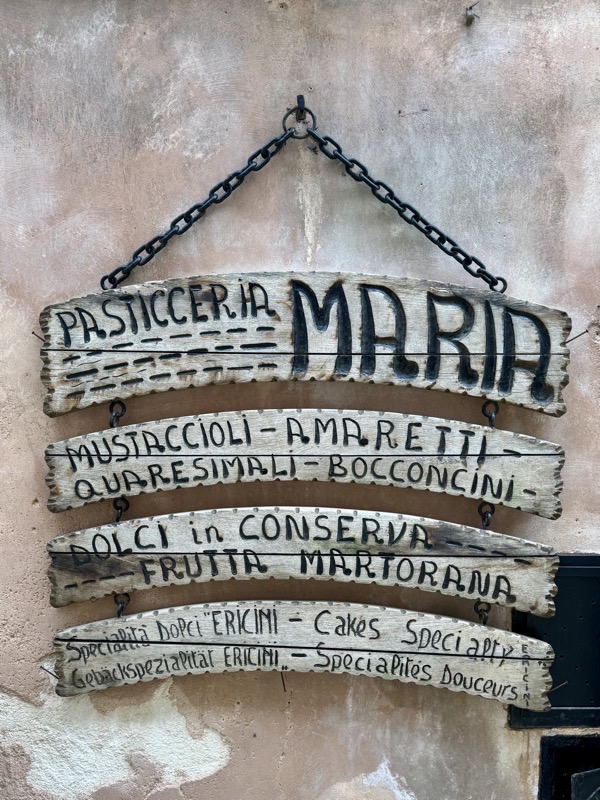
We did not have to hesitate where to stop for a snack. Tom had a solid plan — La Pasticceria di Maria Grammatico. There is a legend behind this place which is actually a true story.
Maria Grammatico is a real person who is still alive. She was born in a poor family one of six siblings. Her father died of a heart attack when she was still little. During the years immediately after the World War II, frequently not being able to afford food for her children, Maria’s mother placed her daughters in a convent. Maria was 11. To sustain them at the time, nuns were using the craft of making almond-based pastries — marzipans — and selling them to the townsfolk. It is there and then among the nuns that Maria learned the art of making Sicilian pasticcini. For fifteen years, she was watching how the pastries were mixed, shaped, baked.
When she turned 22, she left the convent and opened her own shop. She had no posessions but the memory of pastry making, three kilos of almonds, and a grinder. The nuns were not happy about it and would not help her in any way. They wouldn’t even let her back into the convent. Maria persevered and her shop is now a major attraction, if not the symbol of Erice.
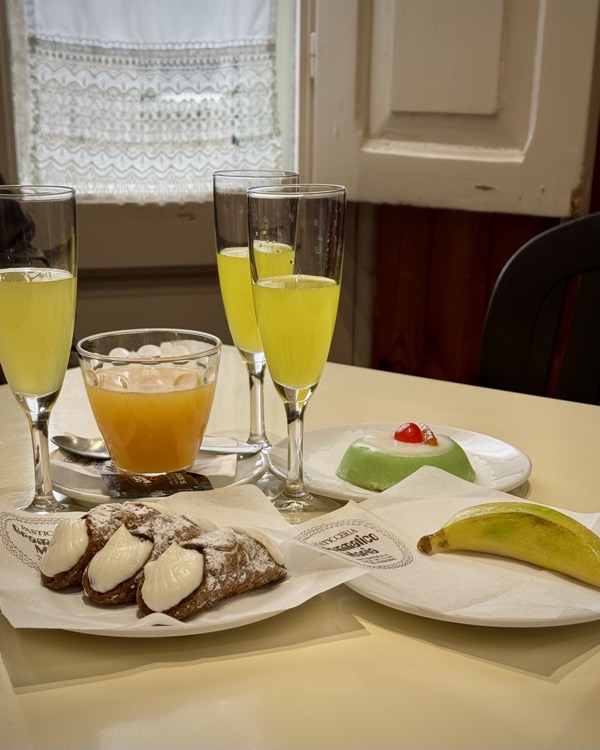
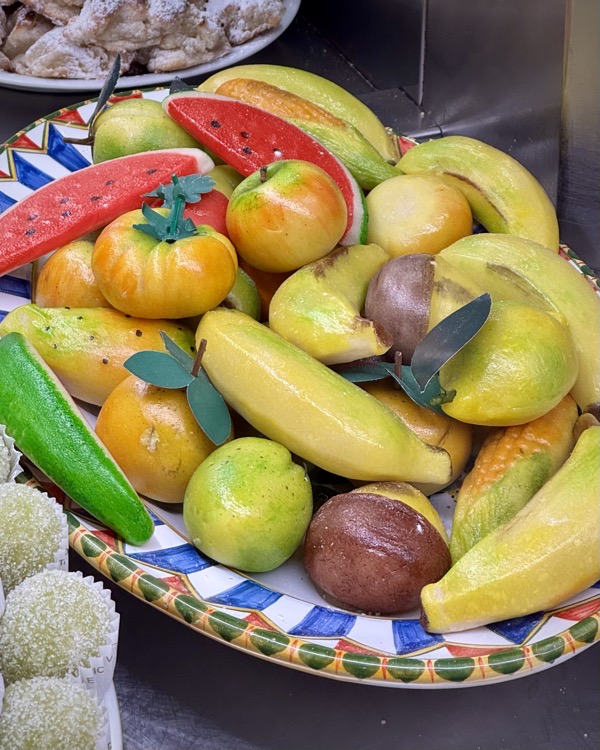
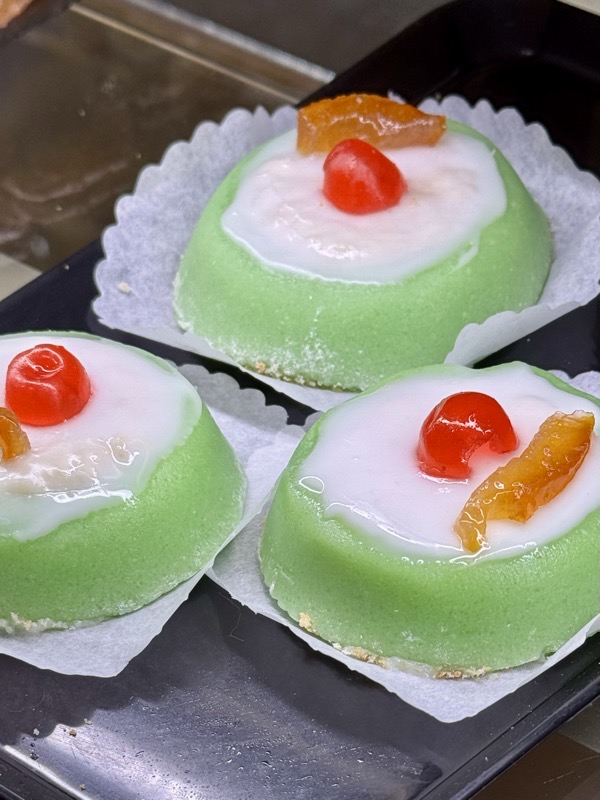
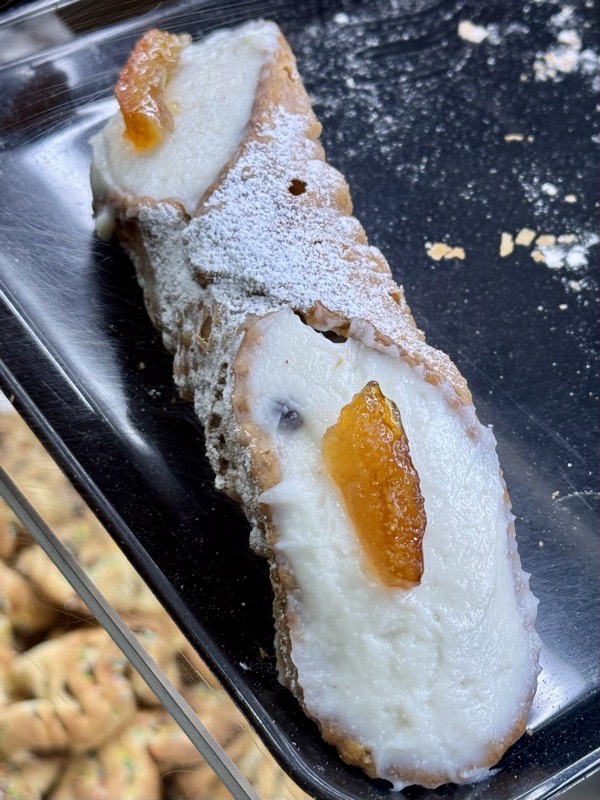
What do we have on our table at Maria Grammatico Paticceria? Cannoli, Frutta Martorana shaped to resemble a banana, and Cassatta Siciliana with limoncello and orange juice. As classic Erice as it gets.
The main counter at the Paticceria was an object of culinary art.
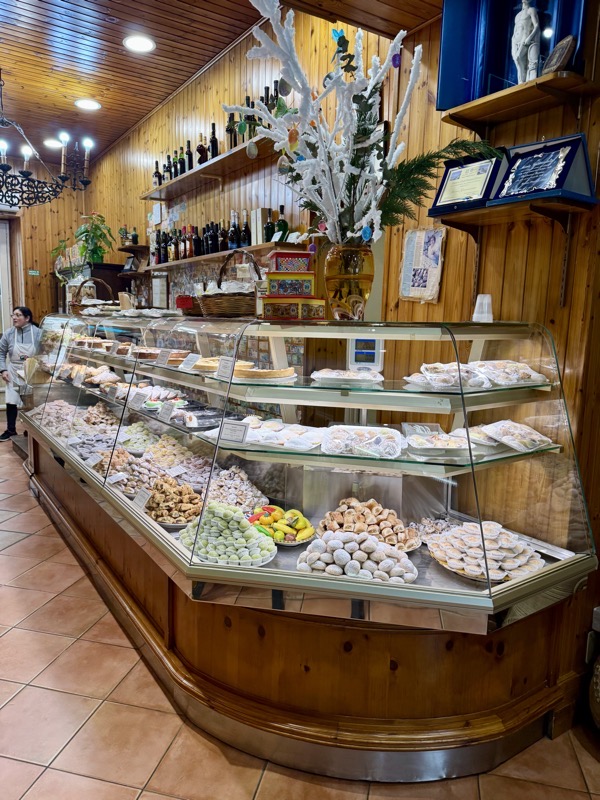
I could not resist taking a video of this patisserie extravaganza.
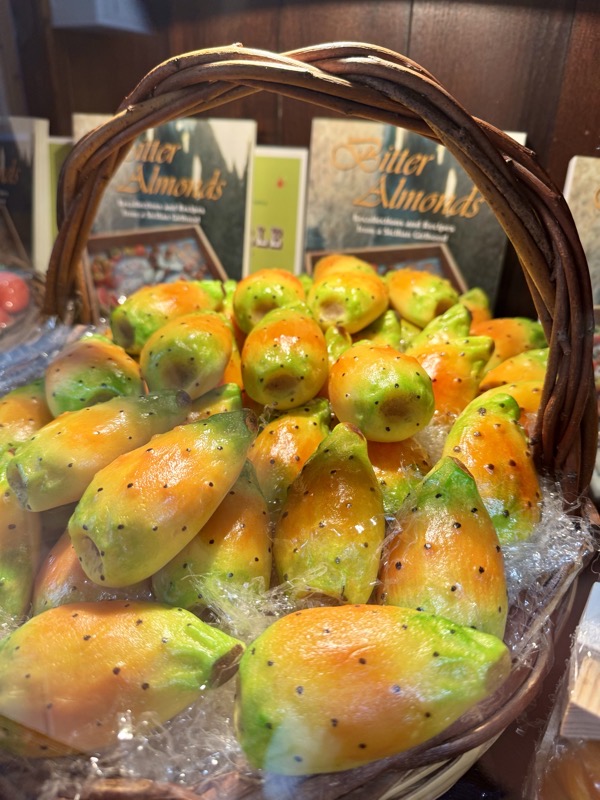
Piles of marzipans shaped as various fruits. Very realistic — stems, pits, blemishes and all.
Cassatta Siciliana, mini cakes made with ricotta, candied fruit and chocolate, flavored with vanilla and maraschino liqueur, encased in sponge cake.
For the world, cannoli are Italian pastries. For Italians, they are a Sicilian delicacy. For Sicilians, the best are made here, at Maria Grammatico Paticceria.
Behind this mound of peach shaped marzipans is a book Bitter Almonds that tells the story of Maria’s life — from poverty to the pastry queen.
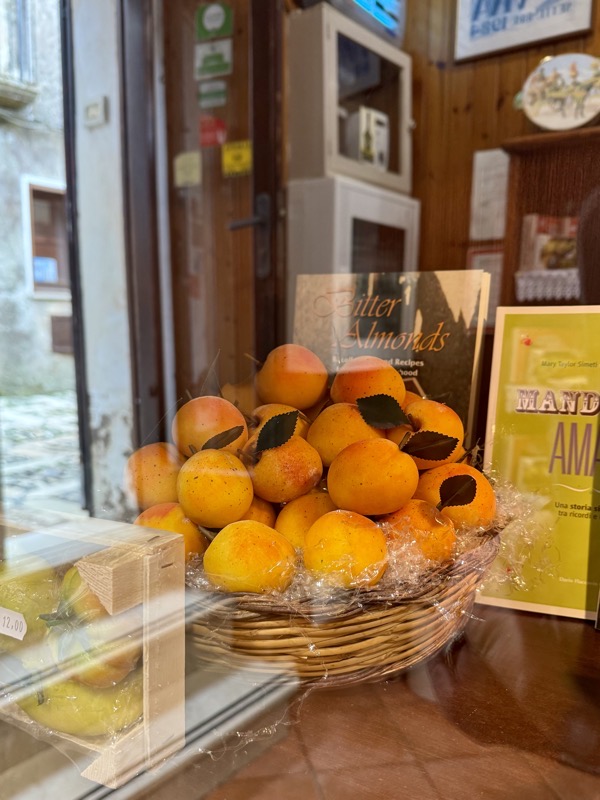
All over the store, there are baskets with colorful frutta di martorana.
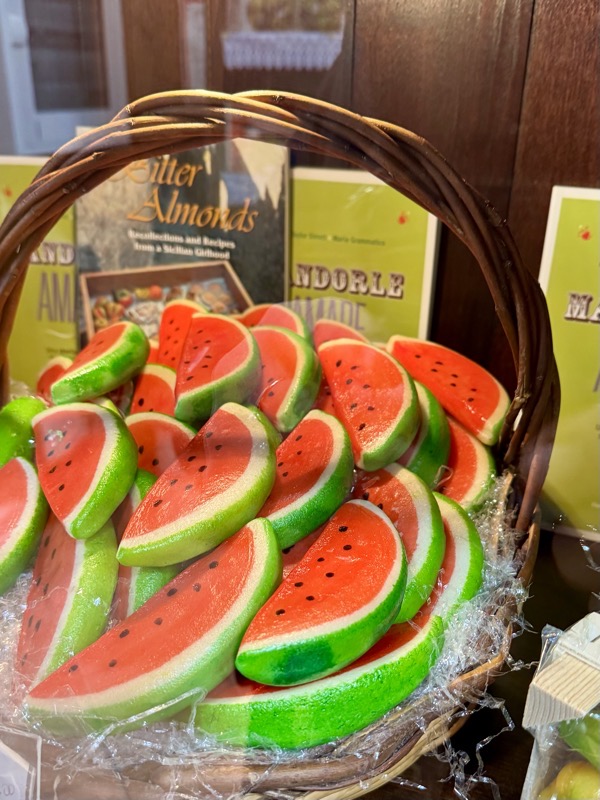
Plates with perfectly arranged sweets are everywhere. And it is hard not wander around looking at the exhibits.
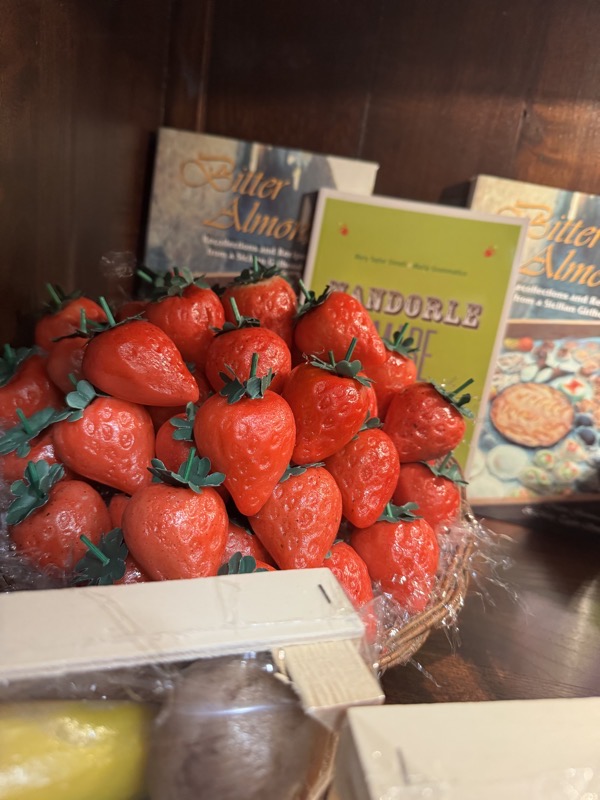
Tangerine marzipans — leaves, stems, brown spots and little dents — so real.
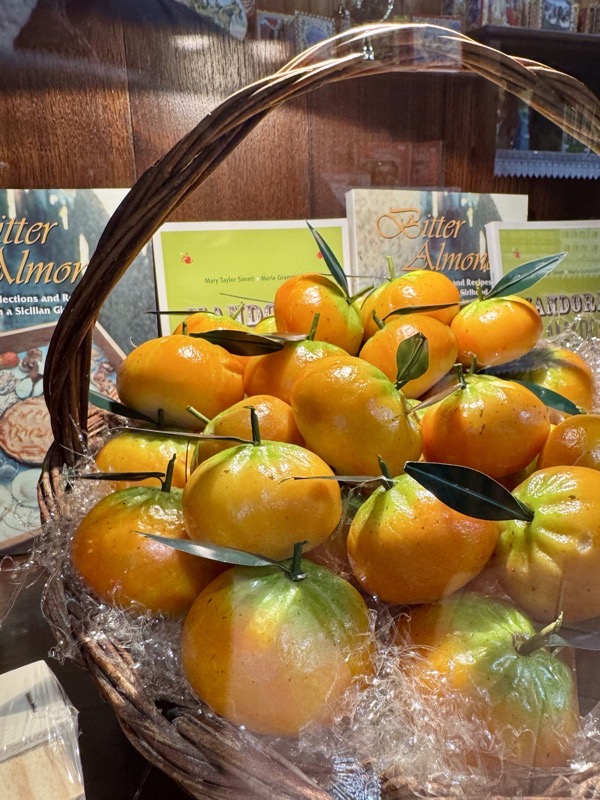
Prickly pears with perfectly accented root and stem ends.
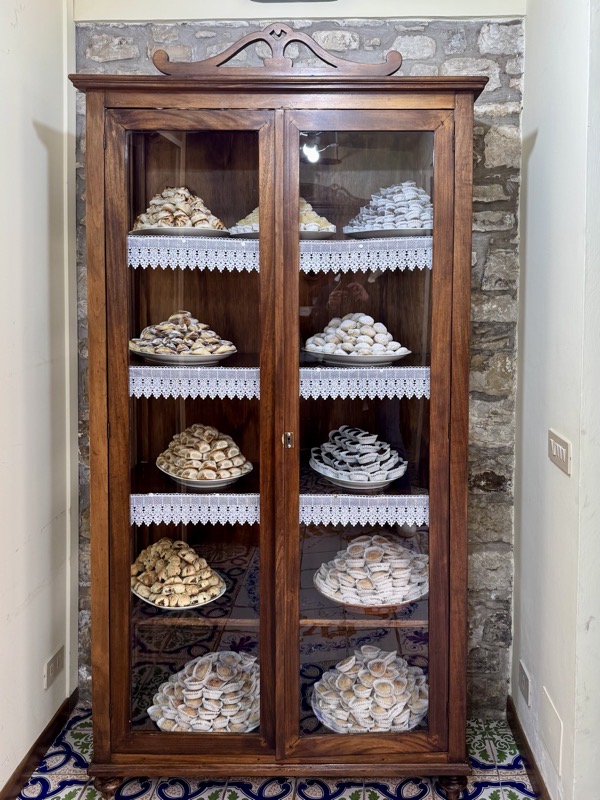
Outside, there was a cupboard with various cookies. Sweets were everywhere here.
From treats, back to the cobblestones.
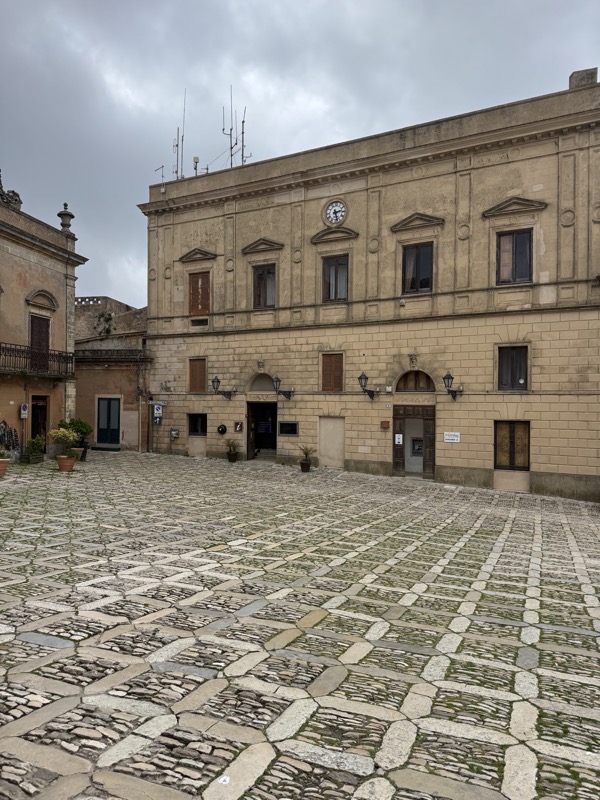
Every so often the streets open into small piazzas. This is the historic town hall of Erice at Piazza della Loggia, the heart of the town where locals usually gather. There are a few shops here, restaurants, and lots of little places that are selling souvenirs. Cobblestones add a lot of character here and create the feeling of an ancient village rather than a town.
Erice does look like a museum under the open sky but people actually live here — there are clean curtains in the windows, potted plants outside and they do look taken care of, but not many people can be seen. Probably chilly weather kept people inside.
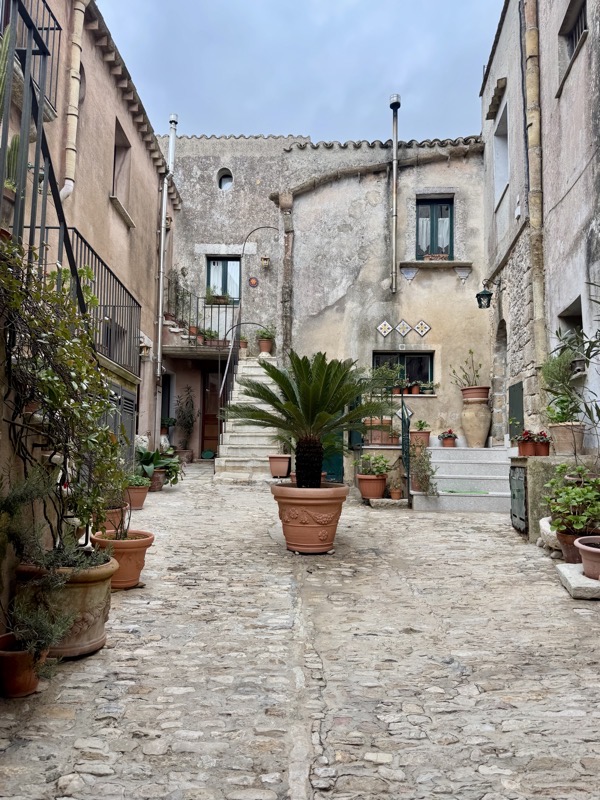
Wandering through the cobblestone streets where there are no stores and restaurants, it feels like time stands still or if it moves, it moves at a different pace.
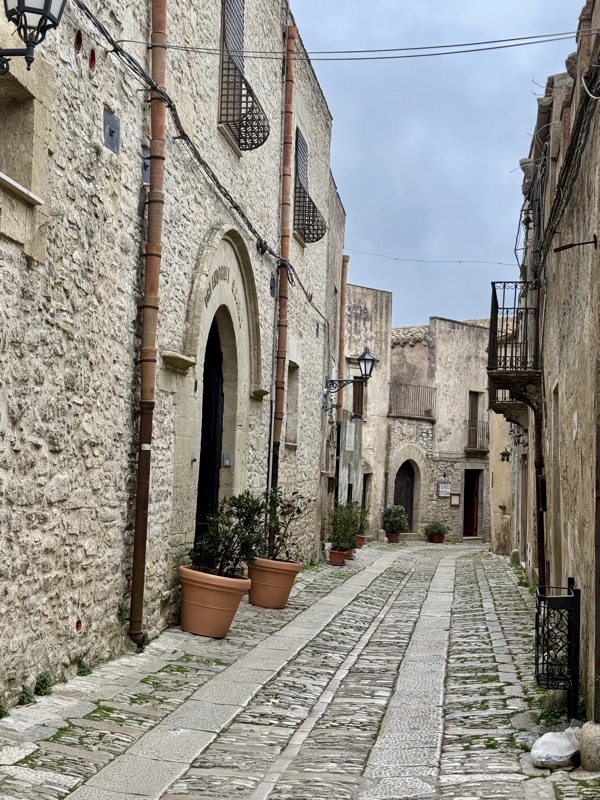
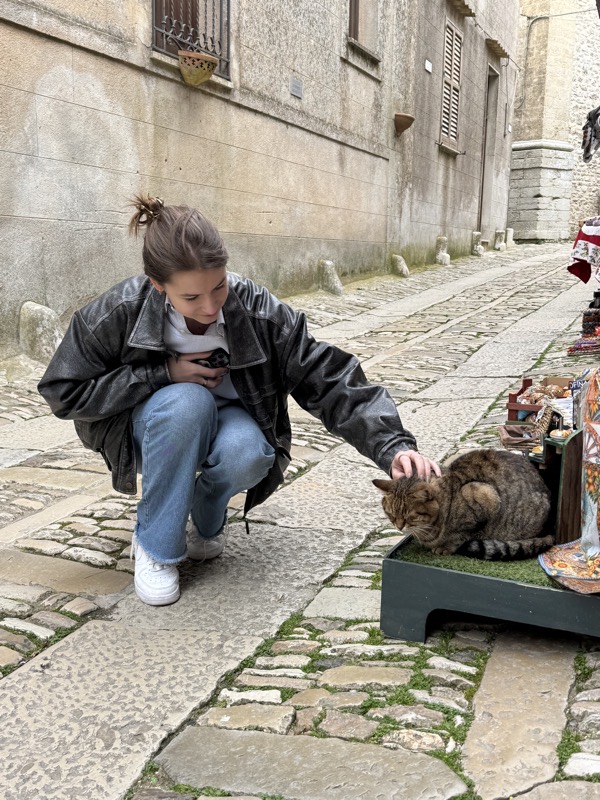
But there are plenty of places to shop, especially for souvenirs. While I was looking at Sicilian ceramics and jewelry, Lizzie found a friend. Cats are so calm and friendly here — always ready for a little scratch behind the ears.
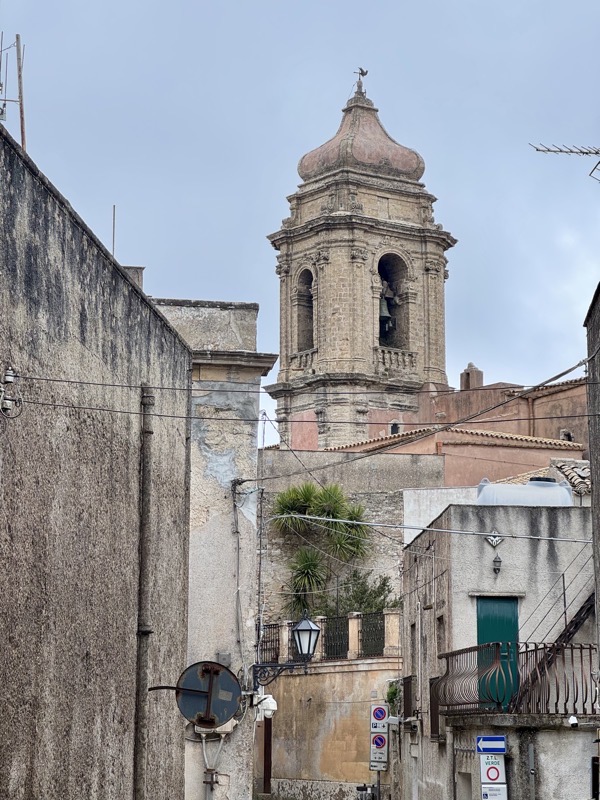
Next on our plan was Chiesa di San Giuliano, Church of Saint Julien.
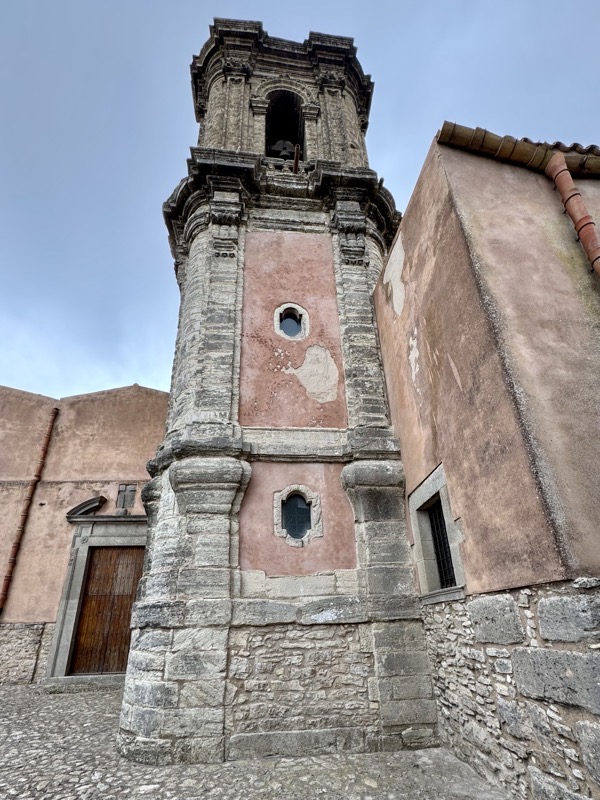
Its bell tower is visible here in the distance. The church was founded in the 11th century, completely rebuilt in 17th, then partially collapsed in the 19th and stood closed for almost a century. It is no less than ten years since it finally has been reopened.
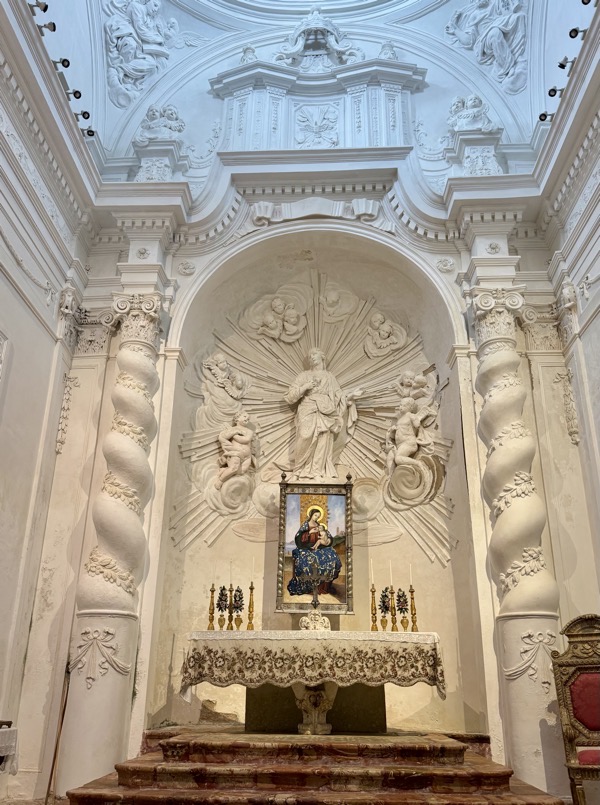
Inside this church is predominantly white. The main altar is a statue of the Sacred Heart of Jesus with a sunburst behind it. Below it is a painting of Madonna and child.
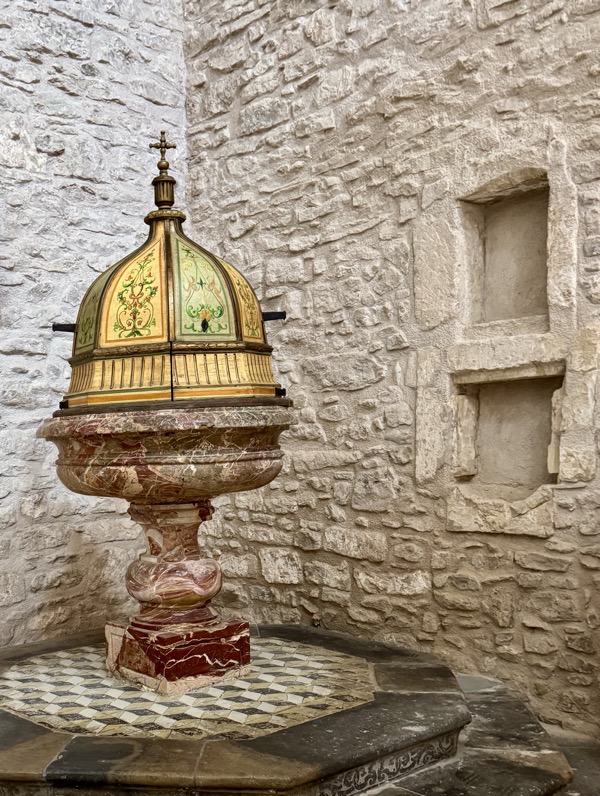
A solemn baptismal font in the corner.
Some of the most emotional and captivating items in this church are the Misteri, small sculptures depicting the final hours of the life of Christ.
An interesting detail. Around Easter celebrations, a council of the Roman Catholic Church always encouraged real people to depict the scenes from these hours. It seemed more genuine and dramatic. However, people started going too far, which resulted in bloody injuries, fights, abuse of alcohol. To eliminate these regrettable situations, real people were substituted by statues carried during the Easter procession.
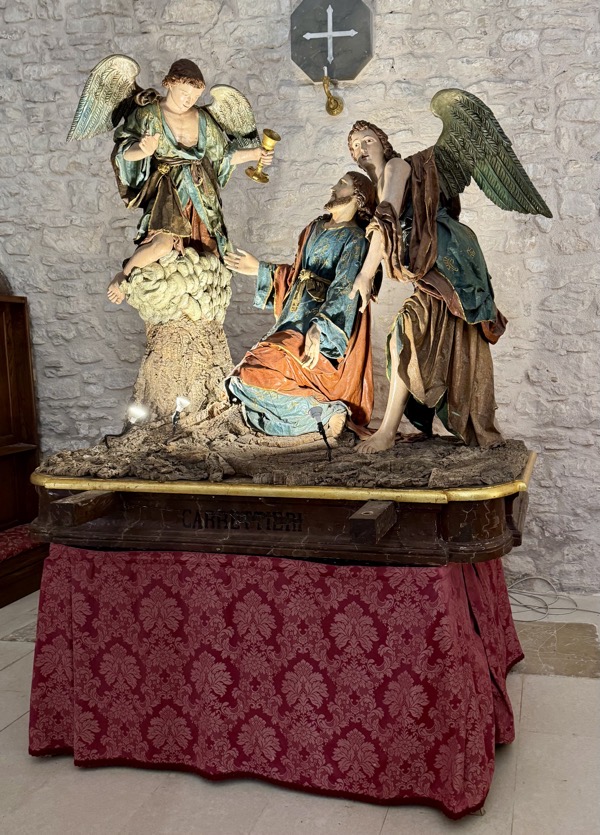
Unlike in other churches, the mood here is different. These sculptures focus more on Chirst’s suffering rather than glory and it is passed on to the visitors.
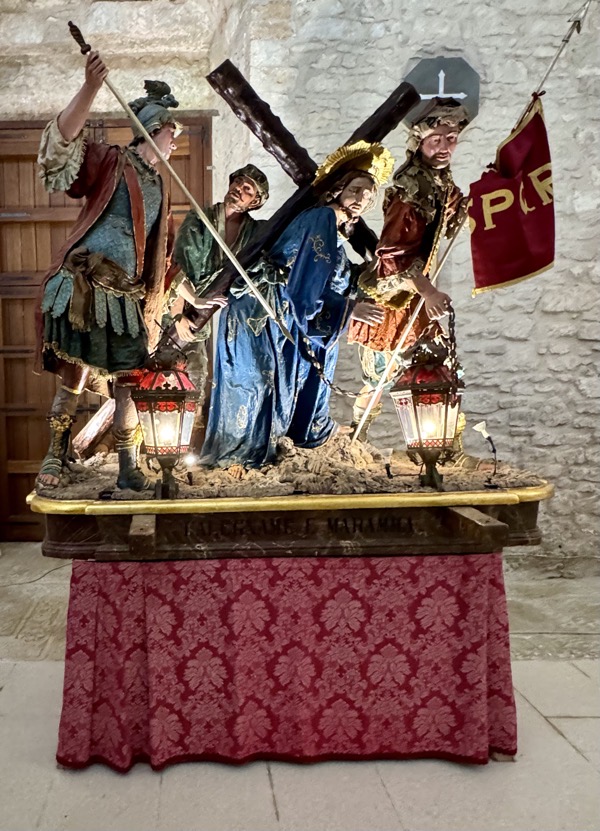
In this scene, Christ is beaten by soldiers. Besides figures themselves, light and shadows add to the somber mood.
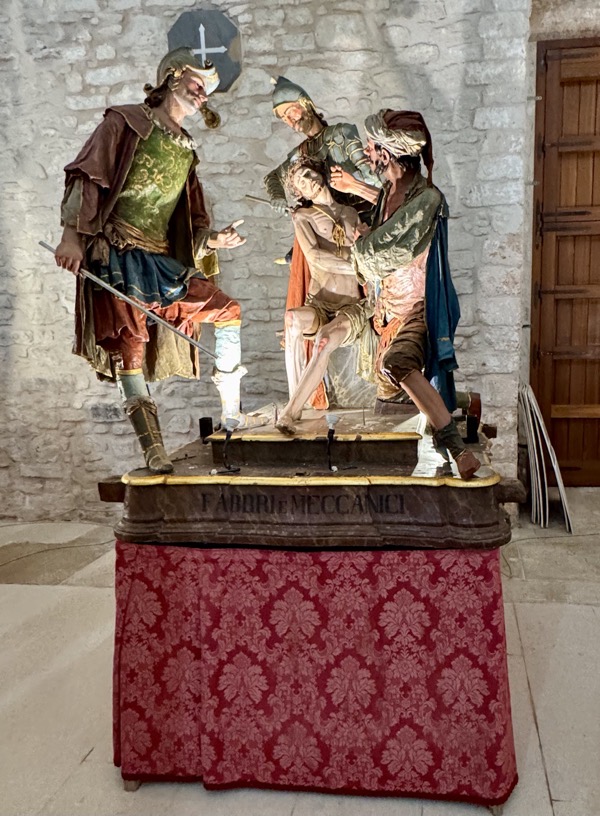
Since these figures have to be carried outside, they had to be light. That’s why they are not made of stone but rather of canvas, wood, and glue.
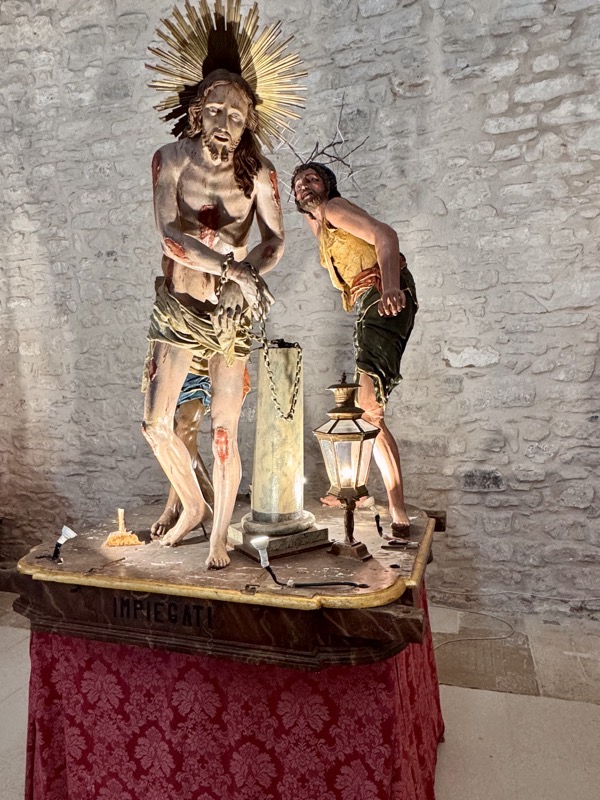
The faces, arms, legs, and other visible anatomical parts were made out of wood. Once they were assembled, cork and straw added body and volume to the figures. Next, the canvas was sewn directly onto the figure. that canvas was first soaked in a special paste and as the paste was drying, artists were creating folds. To create the right skin tone, the figures were colored and polished with walnut and flax oils.
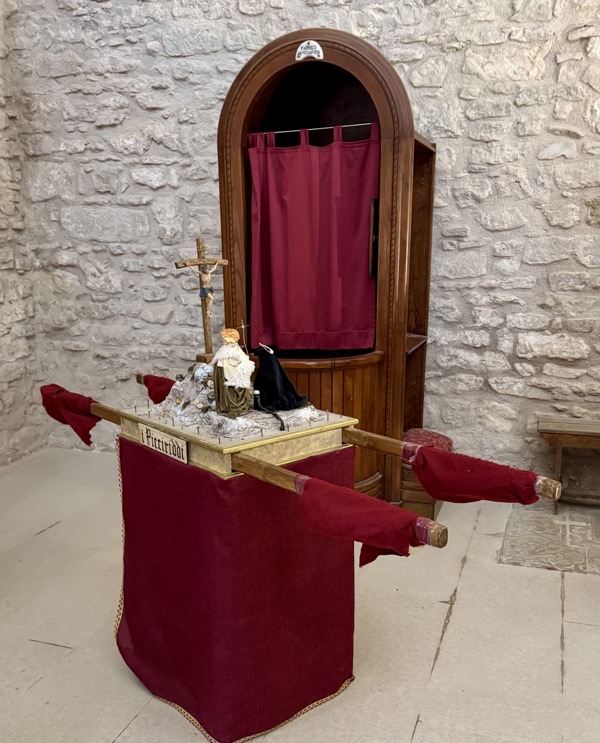
The number of the statues grew and included other episodes of the various traditions besides the 14 stations of the Way of the Cross.
This is our Lady of Sorrow.
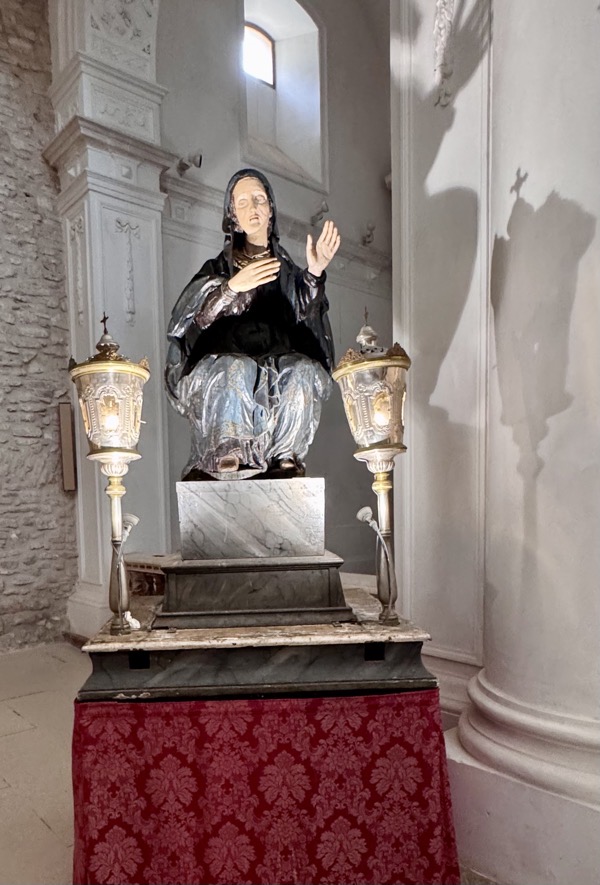
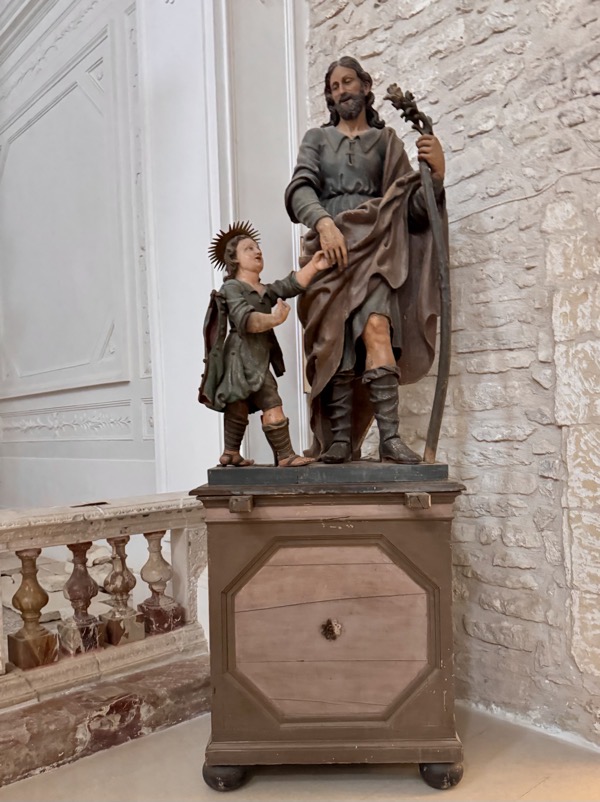
These multi-material, almost life size figures created by Trapanese sculptors are actually very light and can easily be carried during processions.
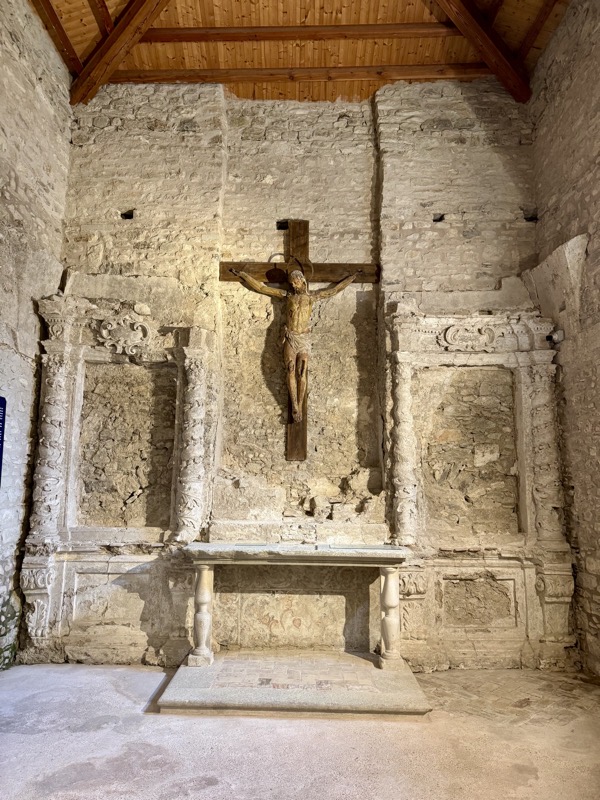
In the back of the church, there is a very ascetic chapel with a wooden crucifix.
Standing here, alone, I felt such a sense of reverence, humility before higher power, maybe even fear, and tried to imagine what little children hundreds of years ago could have experienced in front of these images.
The power of religion…
The bell tower of Chiesa di San Giuliano. It is one of the defining features of Erice.
This town was founded something like two thousand years ago. It is amazing how they managed to keep the medieval vibe and layout basically intact.
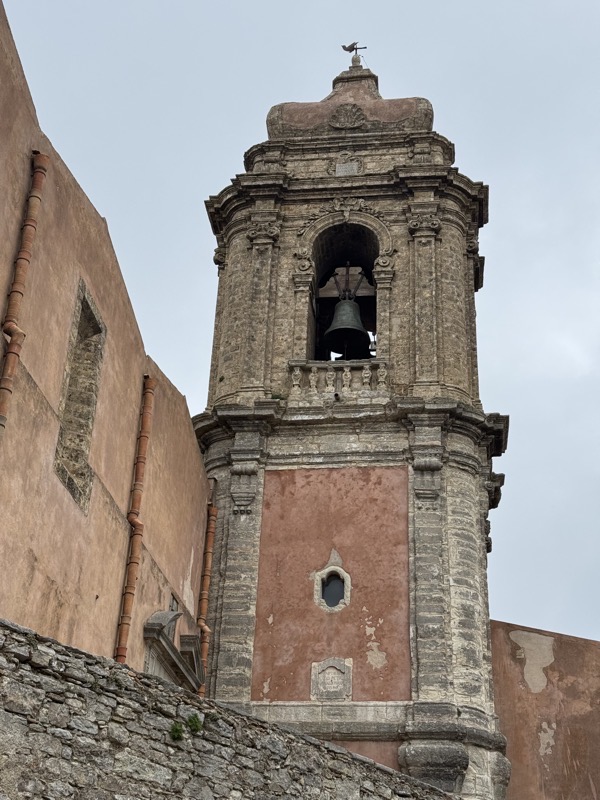
Pagoda-like top of the tower of the pink stone facade.
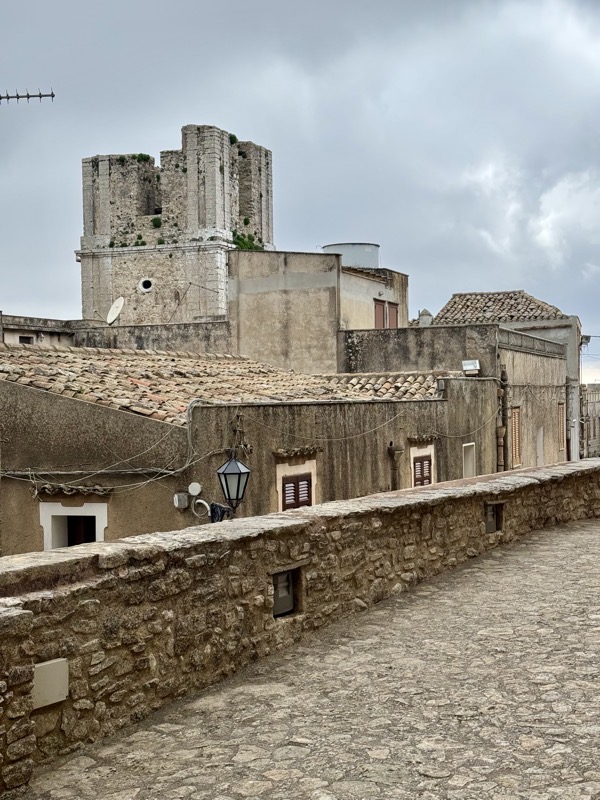
Balio Towers, a medieval fortress that marks the summit of Monte San Giuliano. Over the years, they served as a defensive outpost, a town hall, a center for gathering. There was a time when the land around them was left for grazing and this area was described as “a very bad note of filth and ruin.” Now it is one of the most photographed places in Erice.
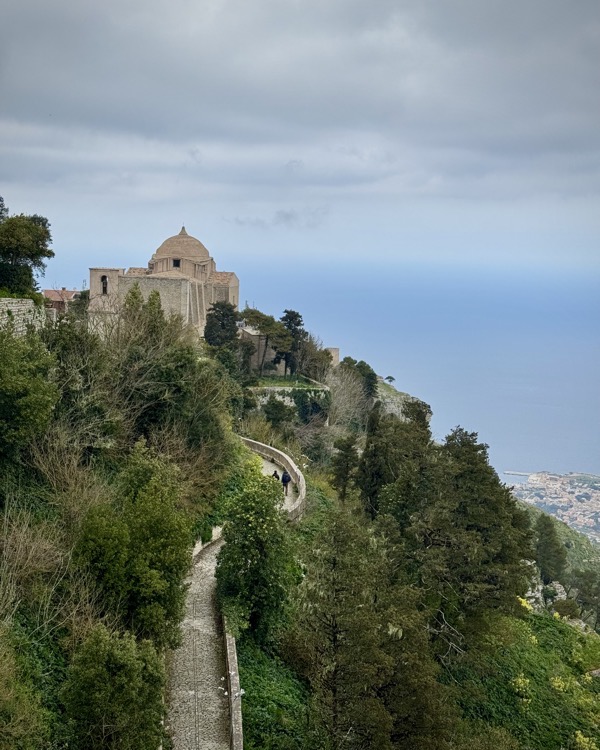
Chiesa Di San Giovanni Battista on the other side of the town, next to Balio Towers, from where we entered. Beautiful views of the valley, coast, and mountains open here.
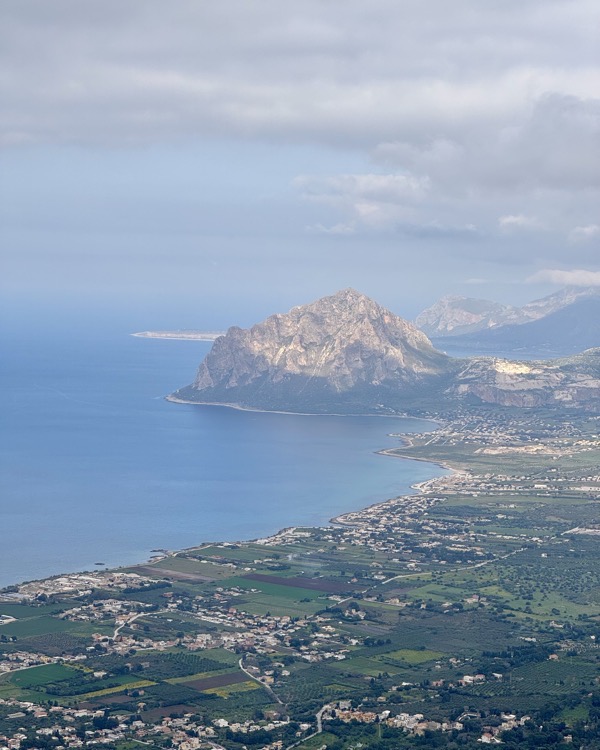
Punta del Saraceno cape in the distance. Behind it, the white sands of San Vito Lo Capo, aka Caribbean of Europe, are peeking. Some say these beaches are so popular that in high season there is no place to put a napkin on the sand never mind a towel.
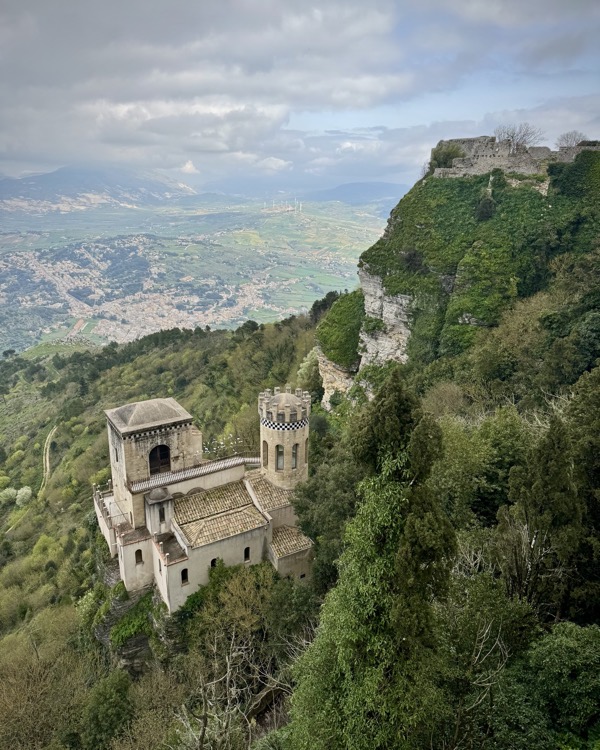
This is the highest point of Erice with Castello di Venere, the Castle of Venus, at the very edge of the cliff. Before going out to sea, sailors came here with offerings asking for good luck.
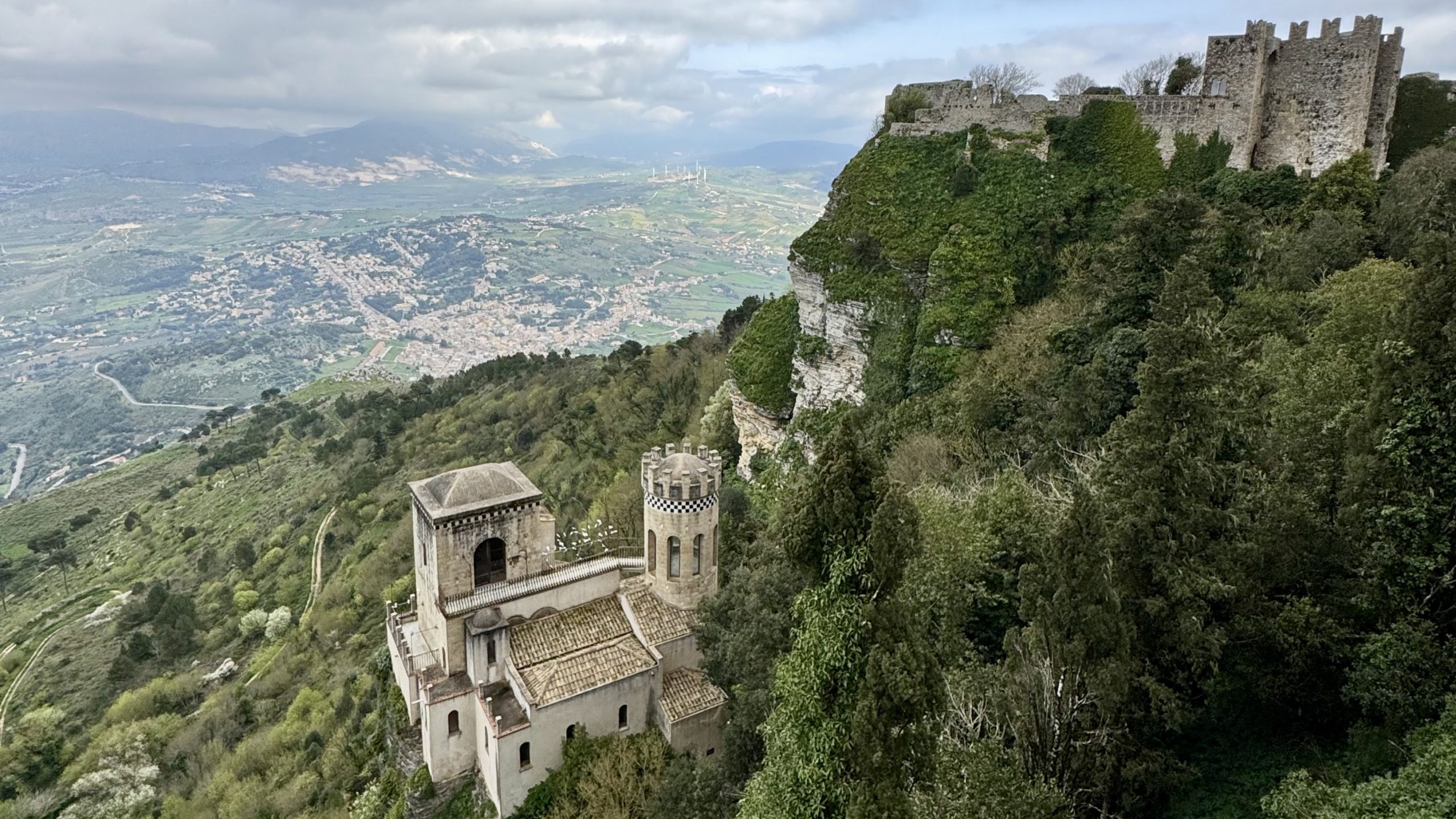
Below it what looks a rook from a chessboard is another castle — Toretta Pepoli — built for those who love art and music to gather. Ruins of the first and a perfect figure of the second framed by cliffs, clouds, and the sky are striking.
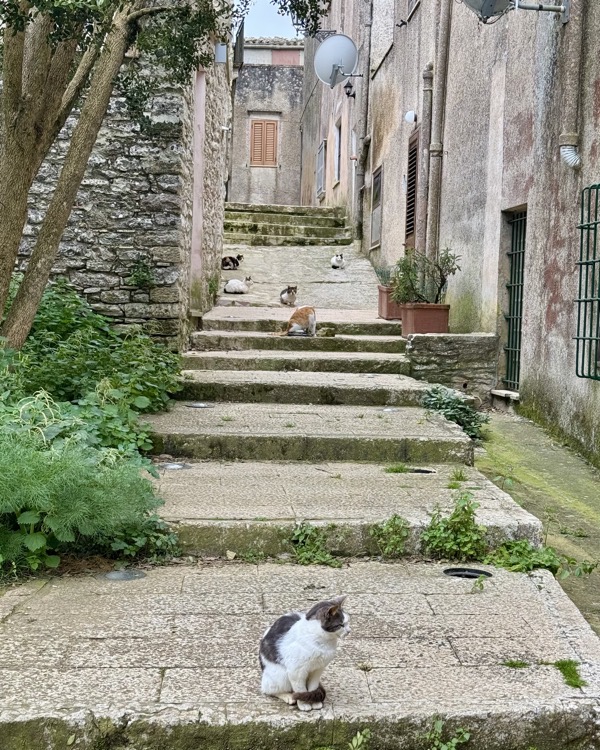
Besides the general architectural charm and all the little details like painted tiles and intricate carvings, what give this place a special cozy feeling is these cats wandering everywhere like they own the place.
We got lucky — on the day of our visit the sky was clear and we could see in all directions towards Tyrrhenian Sea. Locals say that it is a sign that Venus blessed us with her kiss.
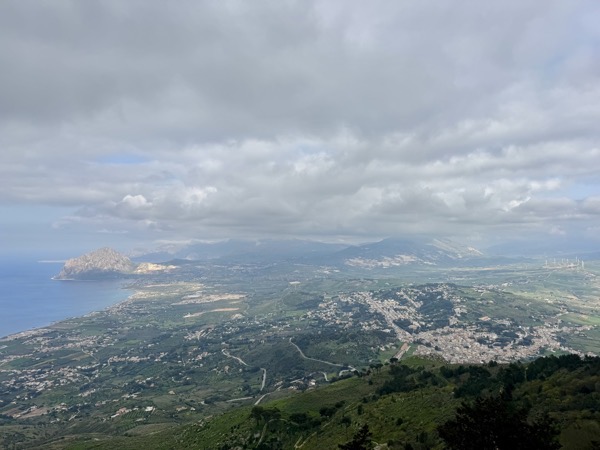
A view from the other side of Monte San Giuliano towards the salt flats of Trapani which will be our next stop.
We were the only car in the parking lot when we arrived here around 10 AM. As we were leaving around 4 pm, the parking lot was full and people were everywhere — even in March.
Drive up was interesting. Drive down? Let’s say it was exhilarating. We proceeded in complete silence.
I took a few snapshots from the GPS monitor of our little rented VW. The road was a steep slope down. To hairpin bends and blind corners shown on the map add a sheer cliff on one side of a two way road that was the width of one car and a little bit. No guard rails. Sitting on my hands, I was looking at my Cary Grant at the wheel and thinking whom I resembled to him the most at the time: Joan Fontaine, Grace Kelly, or Eva Marie Saint.
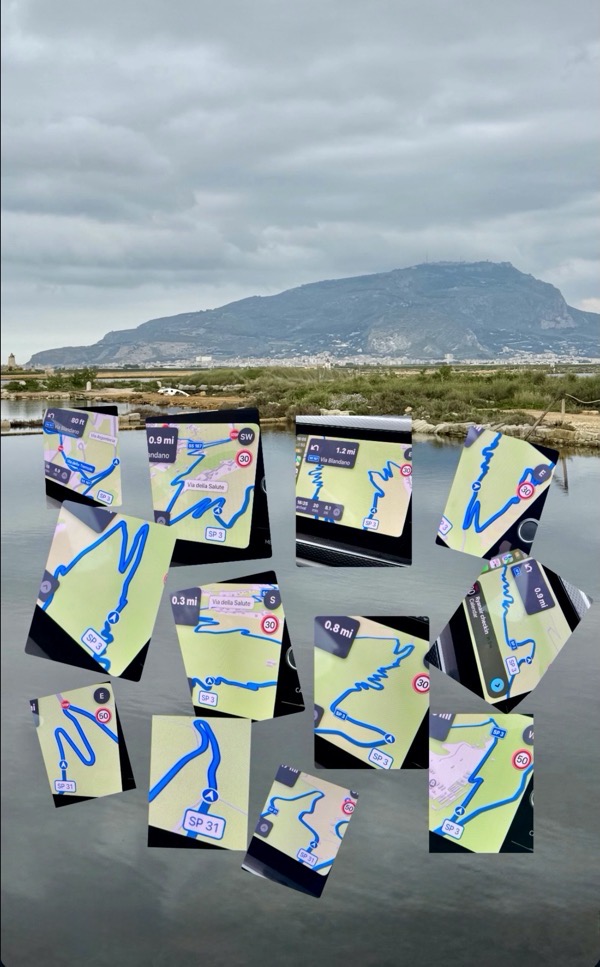
The next stop once we got down were the Salt Pans of Trapani and Paceco, a place where they extract salt, despite all the advances in technology, using old traditional methods. These natural extraction methods make grayish Trapani salt — they do not remove naturally occurring minerals — especially desirable.
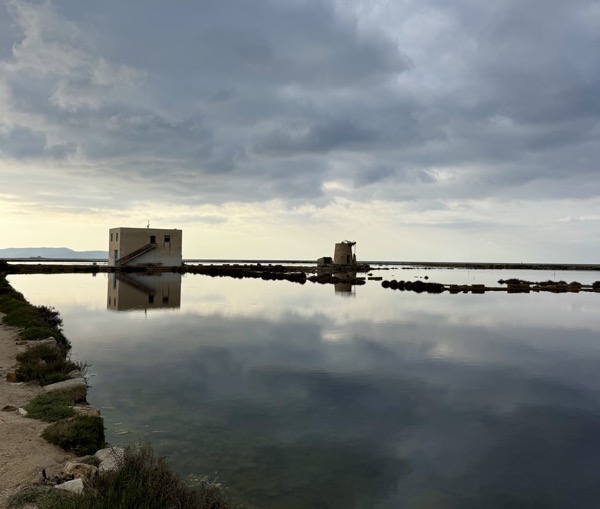
This area is an important coastal wetland that shelters migratory birds. And salt that comes from this area is world famous.
Deep green colors of Erice changed here to the murky blue and gray.
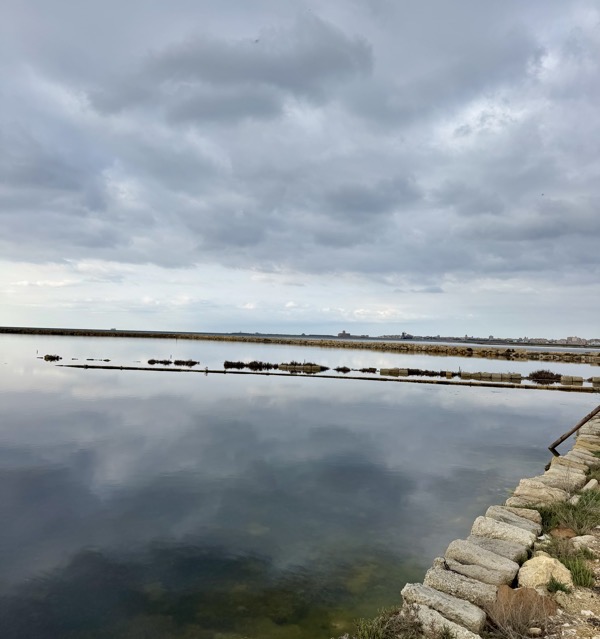
Salt has always been an important element when it came to preserving food, not just flavoring it. Understanding that in times before the refrigeration, Roman emperors imposed a state monopoly on salt production. Trapani salt pans became the most important center of European salt production.
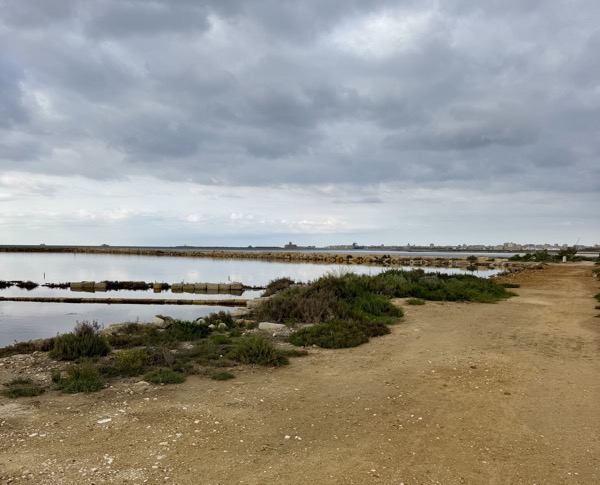
Here, coastal waters are shallow, the sun is strong, so are the winds — an ideal place to make salt.
A series of basins all different sizes and depths create these pans. During the summer months, in these channels and water passages the seawater evaporates and salt crystallizes very quickly.
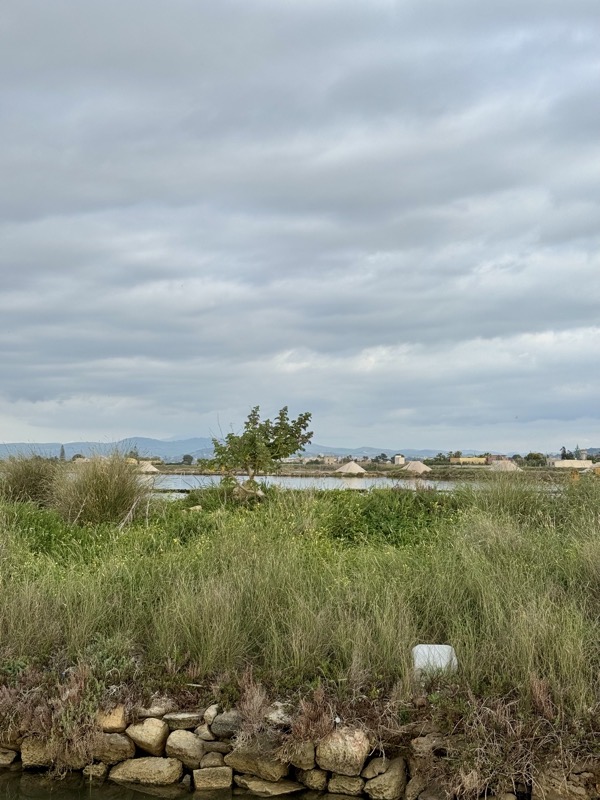
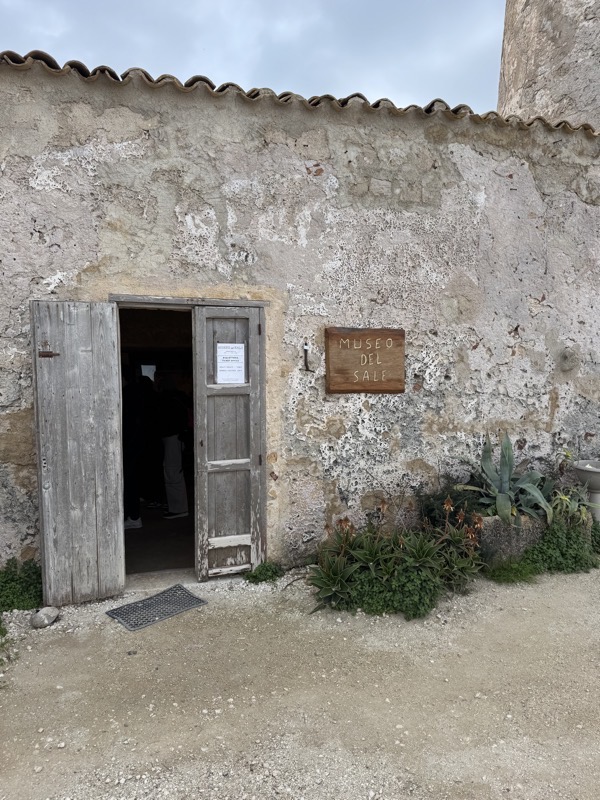
The salt museum on premises hold a full history of how this place came to be and describes the details of the process.
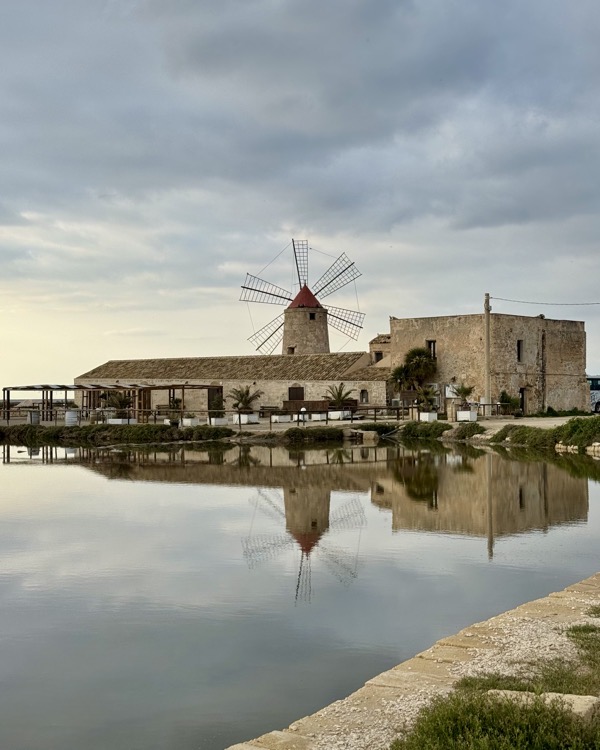
The center here is the old star Dutch mill with six wooden blades. It pumps water between the basins and is also used to grind salt.
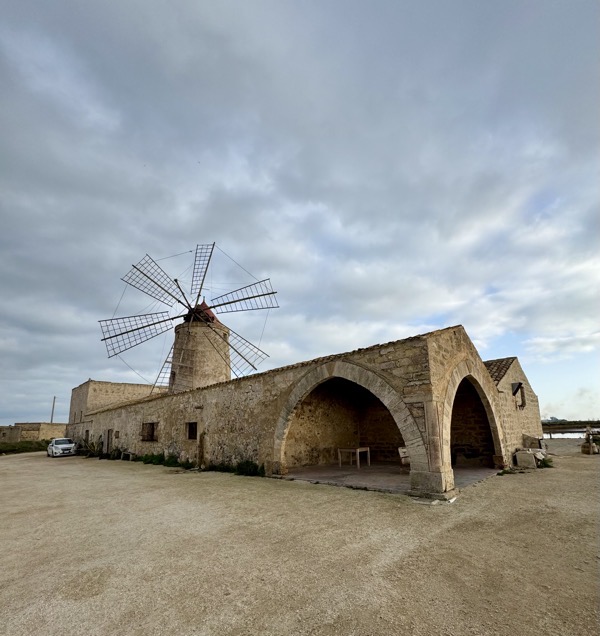
We were here at the dusk and the scenery was magical. These are shallow basins where the sea water is channeled in the spring. All kinds of restrictive signs surround them. The water evaporates here naturally and most of the harvesting takes place during the summer months when the sun is strong and so are the winds.
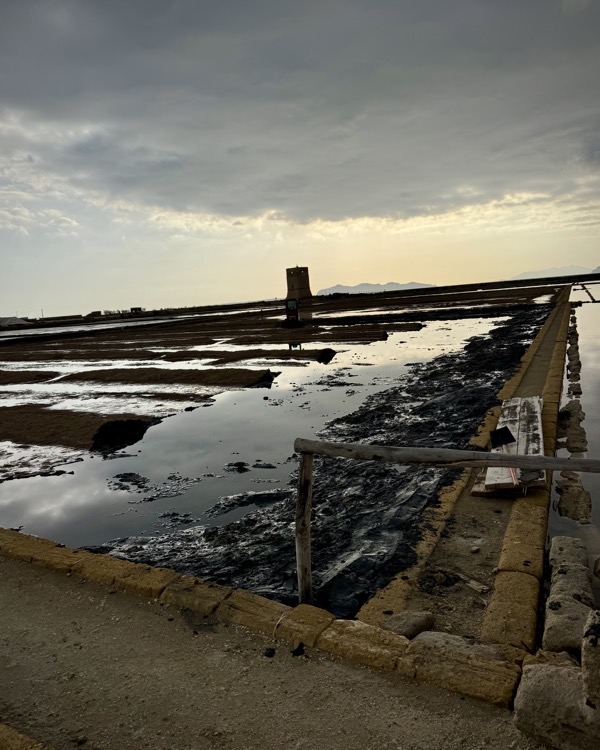
Reflections of the sky in the water with constantly changing colors were almost like painted by an invisible artist. And the colors were changing every few minutes.
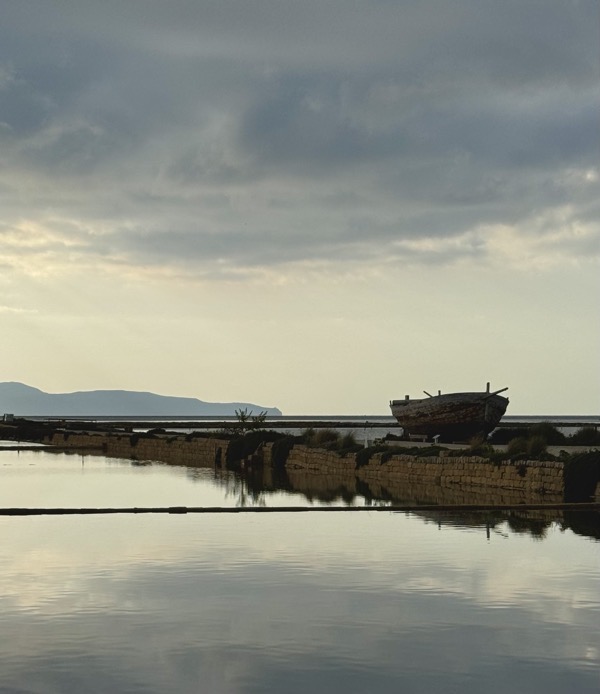
It was hard to stop taking pictures. And even harder now to decide what to keep.
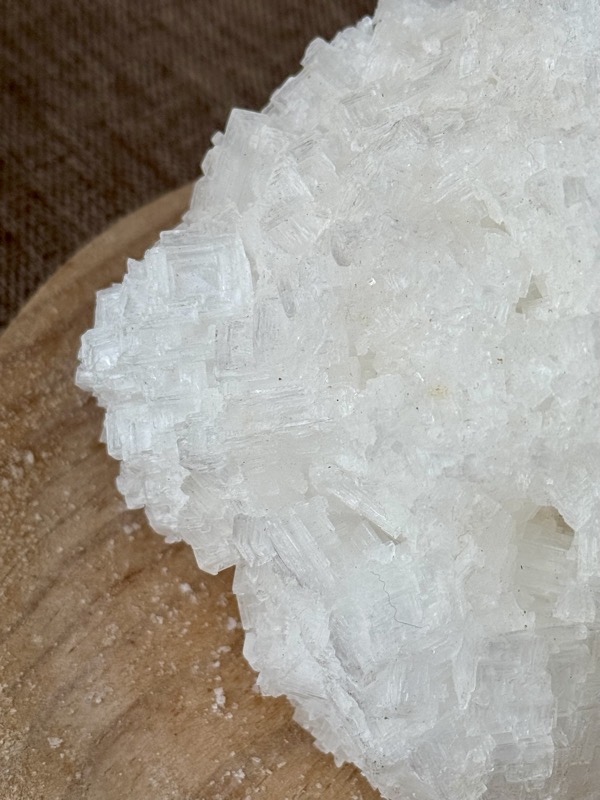
And this is what this place is all about. Obviously, we got a pound of it to bring home.
In the early spring and at the end of the day, there were no people here and the quiet around us made the bird calls and splashes of water with these beautiful views in the background unforgettable. The funky smell of mud I so loved in Crimean lagoons, the sounds, the light, salty air really woke in us all the senses.
Emotionally, this quick stop became one of the main highlights of our trip to Sicily.
There were no special adventures about our lodging for the last night in Sicily. Tom’s arrangements worked smoothly and we got keys to a grand palace in Trapani. Maybe not a palace per se, but it was grand indeed: a multilevel — three floors — townhouse with a wrought iron gate, multiple bathrooms, balconies overlooking Tyrrhenian Sea, modern kitchen. I secretly wished I could have another week just to enjoy this kitchen and the house.
The woman who gave us keys was obviously in a hurry. Anyway, we asked her for an advice where to get dinner. She got excited and her professional smile became more personal:
— My family owns a seafood restaurant and am a little late for my shift. But it’s in Cinisi. Come!
We did.
Our last Sicilian dinner at Vitina Cucina e Pizza had to be pasta, pasta, pasta, seafood, caponata and some pasta.
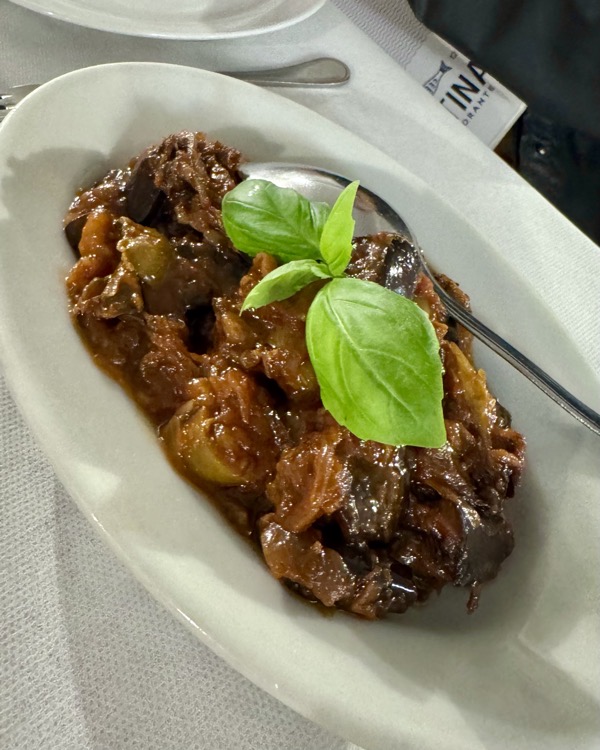
The hostess immediately recognized us and with the menu she brought this plate of caponata:
— On the house.
I hinted at some polpette and carne but my dining companions were settled firm on frutti di mare — cozze to be exact.
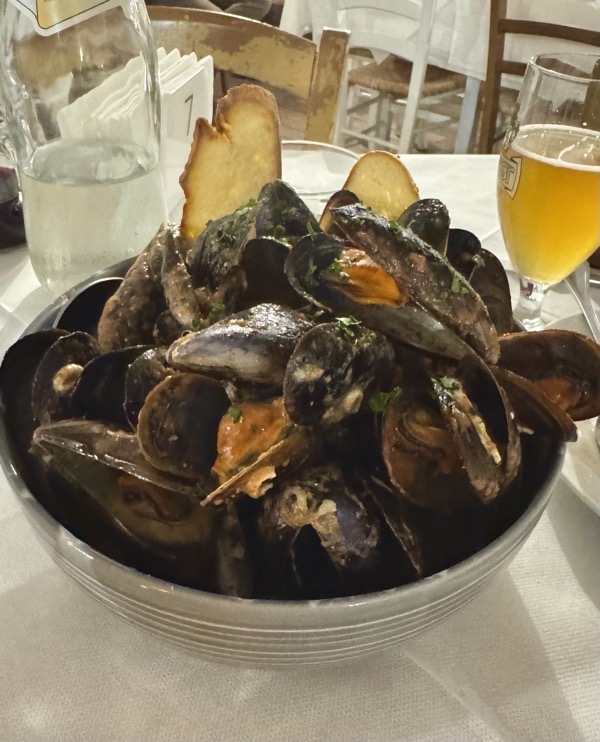
There were various combinations of mussels on the menu to start with: al pomodoro, scoppiate, zuppa. Tom picked al Gorgonzola which sounded strange to me but I kept quiet.
When the bowl arrived, there were no white specks of cheese as I expected but the shells were covered with an unusual sheen. Skeptical and thinking to have a just couple I lost myself in that bowl.
By the way, Gorgonzola mussels are amazing beyond words.
In fact, the mussels were so good that we wanted more with our pasta.
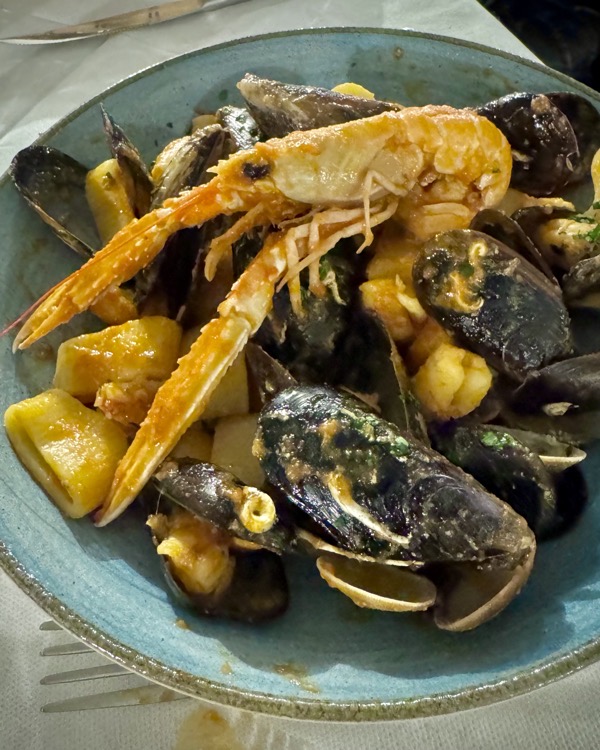
Calamarata Allo Scoglio, fresh pasta shaped like calamari served with mussels, clams, and shrimp in tomato sauce.
Busiata Ricci E Vongole, a traditional Sicilian pasta shaped like a long hollow telephone cord served with sea urchins and clams.
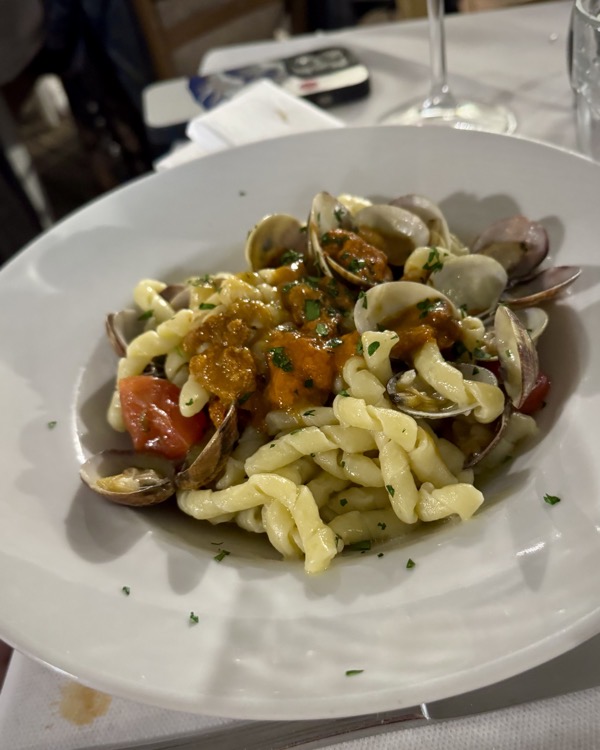
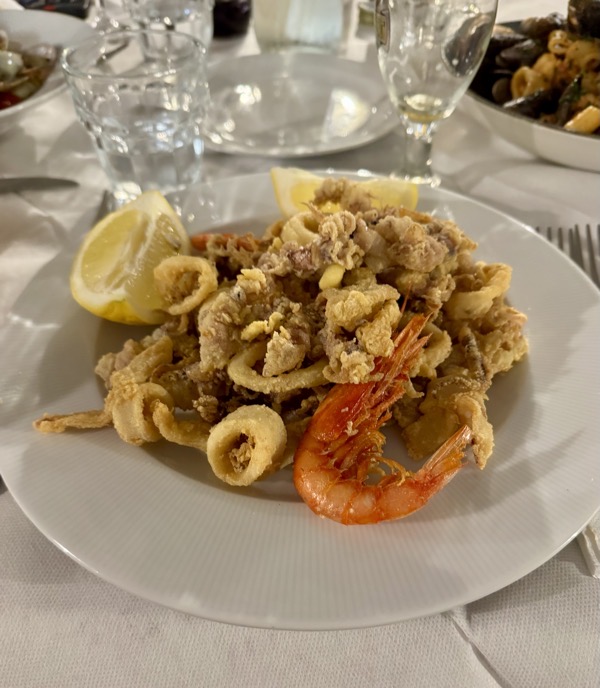
Calamari Fritto — we wanted to see how Sicilian fried calamari compare with those of New Jersey. Well, let’s say I will not be ashamed to take a Sicilian to The Ocean View on the boardwalk in Seaside Heights.
After all that pasta we needed a walk.
Tom drove us to Terrasini to look at the Gulf of Castellamare at night. We parked away from the water to take time and walk through the town.
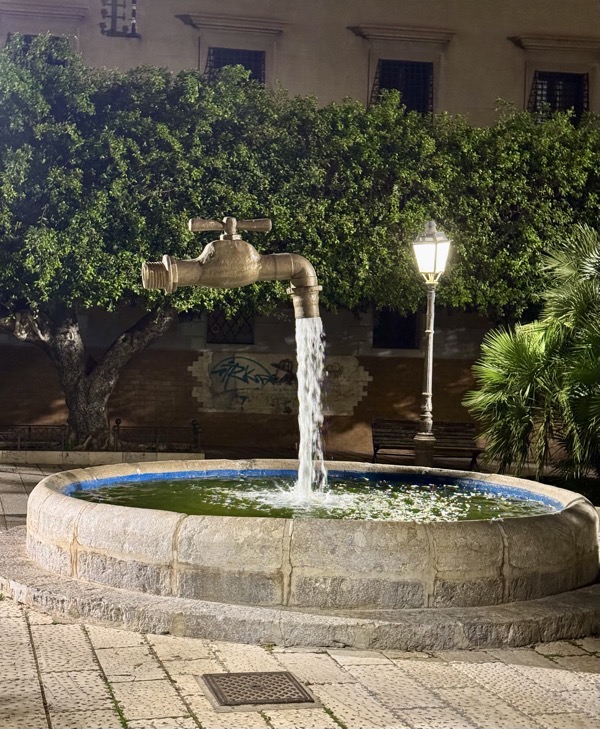
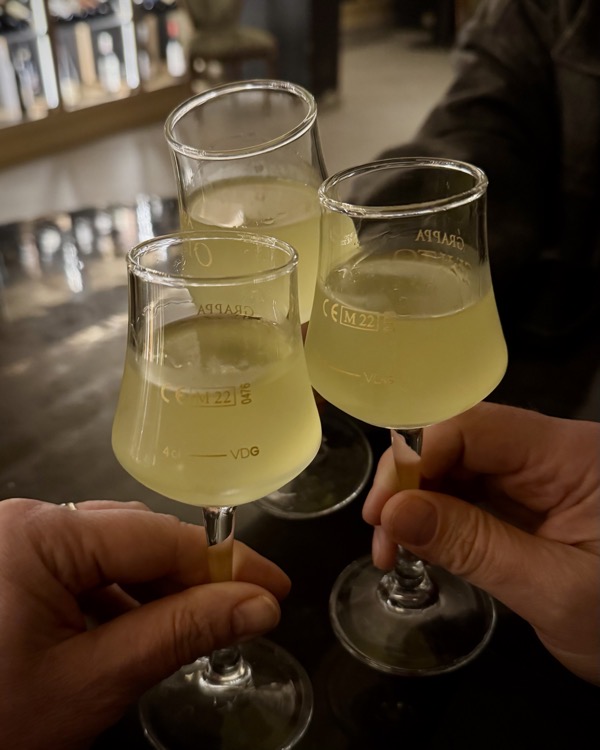
On Piazza Duomo we stopped at the very posh Friend’s Bar for a shot of digestif.
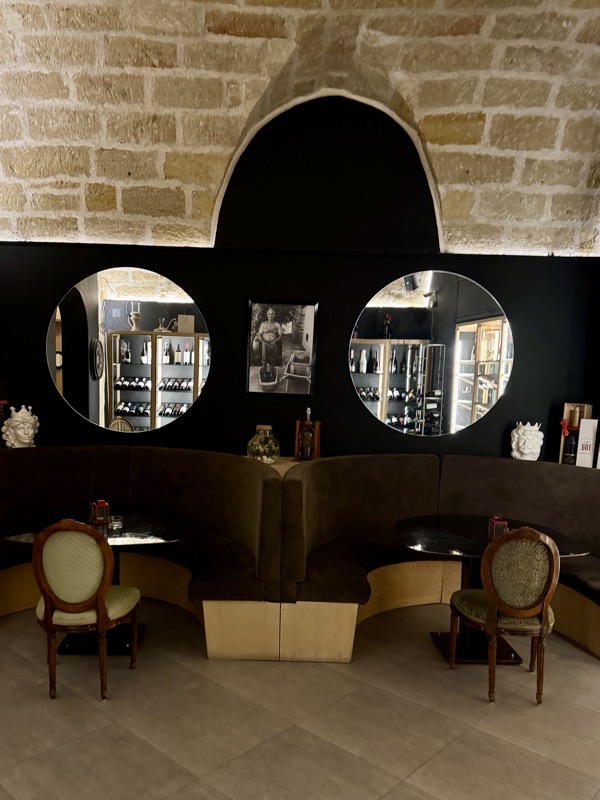
One more toast with limoncello before tomorrow we board planes in different directions. Lizzie — to Istanbul and we — to London.
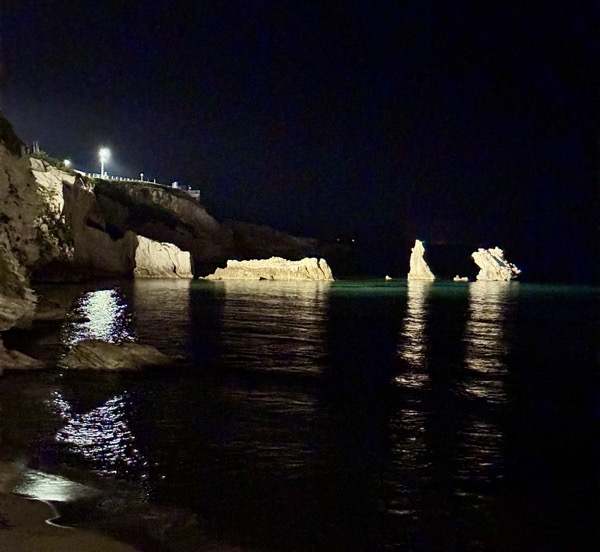
La Praiola beach in Terrasini, a sandy cove among high cliffs. Even at night we could see how clear the water was here. After a week exploring our Trapani kitchen, I could have easily spent another month swimming, sunbathing, and people watching on this beach.